
How to Verify a Remodeling Contractor's License in Washington: L&I Checks, Bonds & Red Flags (Vancouver, WA 2026)
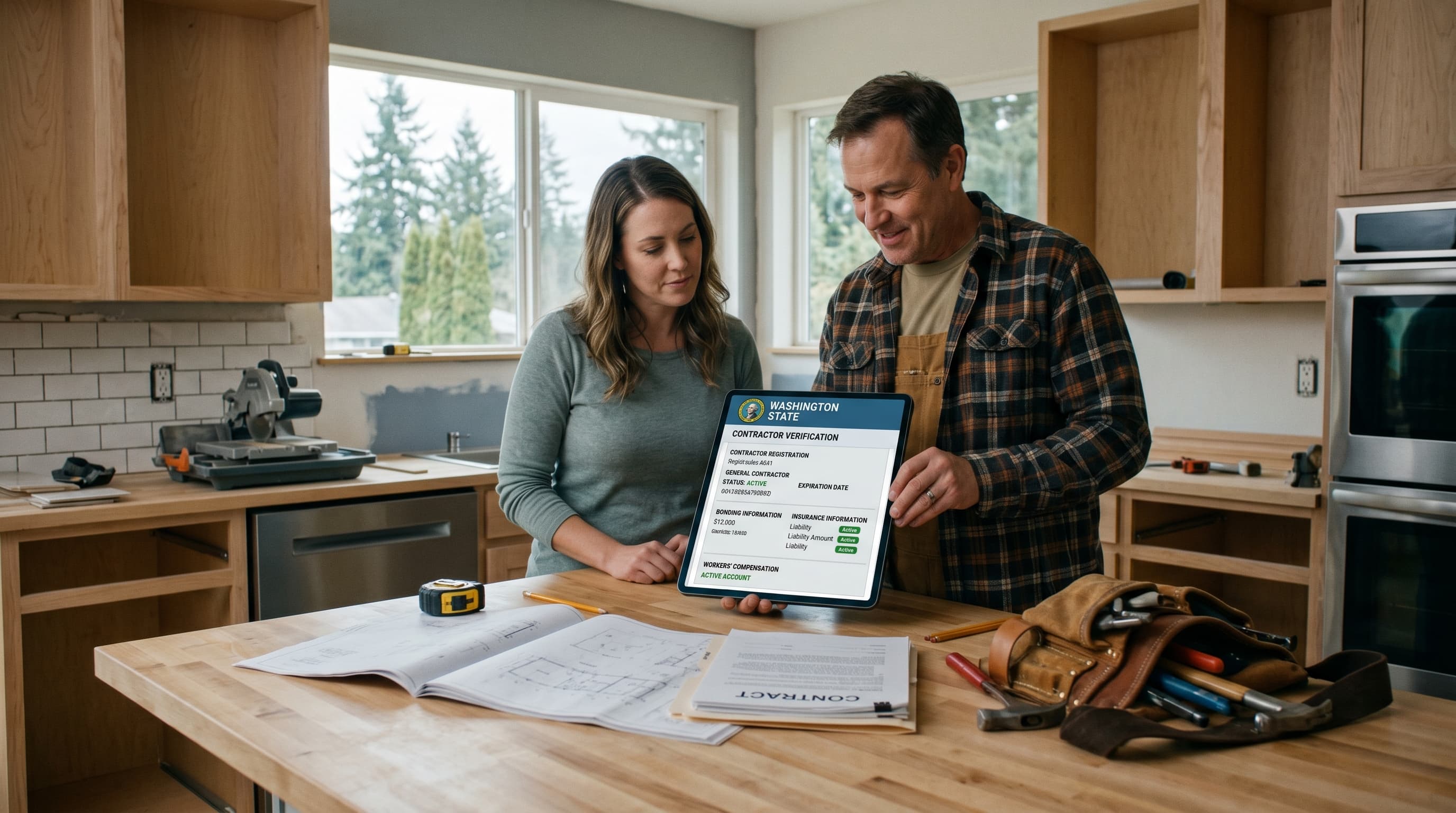
To verify a contractor license in Washington, search the contractor's name, UBI number, or registration number at verify.lni.wa.gov. The Washington Department of Labor & Industries (L&I) database returns license status, bond amount and carrier, insurance policies on file, and every infraction or unsatisfied judgment from the past six years. In Vancouver, WA and Clark County, that five-minute check is the single most important step between a smooth remodel and a five-figure dispute.
This guide walks through exactly what to look for on the L&I record, how Washington's contractor registration law (RCW 18.27) actually protects you, which bond thresholds apply to kitchen, bathroom, ADU, and whole-home projects, and the specific red flags that tend to precede complaints in Clark County. It is written for homeowners comparing bids, not for industry insiders — so every step is actionable in one browser tab.
The 60-Second Verification Checklist
- 1. Open verify.lni.wa.gov and search the legal business name, DBA, or license number.
- 2. Confirm status is Active (not Expired, Suspended, or Revoked).
- 3. Verify license type — General ($12,000 bond) or Specialty ($6,000 bond) — matches your scope.
- 4. Check Bond Status shows In Effect and name a surety company (not "Pending" or blank).
- 5. Confirm General Liability insurance on file with policy dates covering your project window.
- 6. Confirm Workers' Compensation account is active (or sole proprietor with no employees).
- 7. Review Infractions, Lawsuits, and Unsatisfied Judgments sections for the past six years.
- 8. Screenshot everything and save with the bid PDF before signing.
Why verification matters in Washington
Washington is one of the stricter states in the country for contractor registration, and for good reason. According to the Washington State Attorney General's Office, home improvement complaints consistently rank in the top five consumer complaint categories each year. The Washington Department of Labor & Industries investigated more than 2,300 unregistered contractor cases in 2024 alone, issuing roughly $3.2 million in infraction penalties.
The remodeling market in Clark County has grown faster than licensing enforcement can keep up. Vancouver, WA has added more than 35,000 housing units since 2010 per the U.S. Census Bureau, and the Pacific Northwest remodeling backlog remains elevated after the pandemic-era demand spike. That combination — growth, backlog, and out-of-state contractors crossing the I-5 bridge from Oregon — creates ideal conditions for unregistered operators.
Here is what you actually gain from a two-minute verification.
What you lose by hiring unregistered
Each protection is forfeited when you hire an unregistered contractor. Bond claim ceiling reflects the $12,000 general-contractor bond under RCW 18.27.040.
RCW 18.27 in plain English
Washington's contractor registration law lives in RCW Chapter 18.27. You do not need to read all of it — four provisions do most of the work.
- RCW 18.27.020 — Any contractor performing work over $600 (labor plus materials) must register with L&I. Gross misdemeanor for a first offense; potential Class C felony for repeat offenses.
- RCW 18.27.040 — Sets the surety bond requirement: $12,000 for general contractors, $6,000 for specialty contractors, posted with an admitted surety company.
- RCW 18.27.050 — Requires proof of general liability insurance ($250,000 public liability, $50,000 property damage minimums) and, where applicable, workers' compensation coverage.
- RCW 18.27.080 — Prohibits unregistered contractors from filing liens, filing lawsuits to collect payment, or even advertising in Washington. This is your strongest homeowner-side lever if something goes wrong.
The practical effect is that every legitimate Vancouver, WA contractor has a registration number, a bond on file, and insurance certificates — and the state keeps a public record of all three. If any piece is missing, you are taking on risk the law intended to shift to the contractor.
Step 1: Run the L&I lookup
Go directly to secure.lni.wa.gov/verify/ (the official L&I Contractor, Tradesperson, & Business Verification tool, commonly referenced as verify.lni.wa.gov). Bookmark it. Do not use third-party “license lookup” sites — they often return stale data or affiliate listings.
You can search by any of the following:
- Contractor or business name (partial names work)
- Contractor registration number (printed on every legal proposal, ad, and truck wrap in Washington)
- UBI (Unified Business Identifier) — 9 digits
- Owner's name or DBA
Pro tip: Search by the exact legal business name on the bid or contract — not the marketing name. It is common for a contractor to advertise under one brand while carrying the license under an LLC with a slightly different spelling. Mismatched names between the bid and the L&I record are a disqualifying signal on their own.
Step 2: Decode the license record
The L&I result page has ten or more fields. Five of them actually matter for your verification.
| Field | What to look for | Red flag |
|---|---|---|
| License Status | Active | Expired, Suspended, Revoked, Closed |
| License Type | General or specific Specialty | Specialty mismatched to project scope |
| Effective / Expiration Dates | Covers your entire project window | Expires mid-project with no renewal on file |
| Bond Status | In Effect, named surety, $12,000 or $6,000 | Pending, cancelled, below statutory minimum |
| Insurance on File | Active policy, dates current | Missing, expired, or carrier dropped |
| Infractions / Lawsuits | None, or closed / resolved | Active or repeated over 3+ years |
Save screenshots of the verification record the day you sign. If the record changes later — a suspension, a new infraction, a lapsed bond — your saved copy is evidence of what the contractor represented at contract signing.
Step 3: Verify the surety bond
The contractor bond is a small pool of money set aside specifically to pay homeowner and supplier claims when a contractor defaults, abandons a project, or violates the contract. In Washington, it is your primary financial recourse short of a lawsuit.
Washington contractor bond minimums (RCW 18.27.040)
General contractor: $12,000
Required for any project combining two or more unrelated trades (most remodels).
Specialty contractor: $6,000
Covers a single trade such as roofing, siding, flooring, or painting.
How to read the bond row on the L&I record:
- Status: Must say In Effect. "Pending," "Cancelled," or a blank carrier means there is no active bond to claim against.
- Surety company: Should be a recognized admitted carrier (e.g., Travelers, Old Republic, Merchants). An unnamed or out-of-state non-admitted carrier is worth a second look.
- Effective date: Bonds expire if premiums lapse. An expired bond is not valid coverage even if the license status still shows Active in the same week.
- Bond amount: Must meet the $12,000 or $6,000 minimum. Some contractors voluntarily carry higher bonds ($25,000+) as a trust signal.
Pro tip: the L&I record shows the bond number and surety. If a dispute arises, that is the information you need to file a bond claim — not the contractor's phone number, which often stops working at exactly the moment you need it.
Step 4: Confirm insurance coverage
The L&I record confirms insurance is on file, but that is a snapshot, not a live feed. Policies lapse between L&I refreshes. Before you sign, request a current Certificate of Insurance (COI) directly from the contractor and, ideally, call the listed carrier to confirm the policy is active.
Three coverages to verify for a Vancouver, WA remodel:
- General liability: Minimum $1 million per occurrence is the Pacific Northwest industry norm, well above the $250,000 statutory floor. Covers damage to your home, neighboring property, and third-party injury.
- Workers' compensation: Required in Washington for any contractor with employees. Verified on the same L&I lookup. If a contractor claims "I don't need workers' comp, I'm a sole proprietor" but subcontractors will be on your job site, the subs must each carry their own coverage or be covered under a general policy.
- Commercial auto: Often overlooked, but relevant when dumpsters, lifts, or heavy equipment are delivered to a driveway.
Ask to be listed as an Additional Insured for the project period on the general liability policy. Reputable contractors handle this in a day at no cost — the carrier issues an updated COI showing your name. A contractor who cannot or will not do this is worth removing from your shortlist.
Step 5: Read infractions and judgments
Scroll to the bottom of the L&I record. The Infractions & Citations, Lawsuits Against Bond, and Unsatisfied Judgments sections tell you what past homeowners and suppliers experienced — in public record form.
Not all infractions are equal. Here is a calibration for Vancouver, WA and Clark County contractors.
How to weight L&I infractions (severity × recency)
Rule of thumb: weight recency heavier than severity for hiring decisions. A resolved lawsuit from 2018 is far less predictive than an unresolved complaint from last quarter.
Calibration guide:
- Single infraction, 5+ years old, resolved: Mostly noise. Most contractors with long histories have at least one paperwork issue.
- Pattern of infractions across 3+ years: Structural problem. The pattern predicts recurrence.
- Unsatisfied judgment or unpaid bond claim: Disqualifying until the contractor provides documentation of resolution and explains the circumstances.
- Recent suspension — now reactivated: Ask directly what happened. If the answer is vague or blames "paperwork," move on.
Want to Skip the Research?
GVX Remodeling is licensed, bonded, and insured in Washington with 25+ years of experience and 491 combined reviews across Google, Yelp, Facebook, and BBB. Verify us at verify.lni.wa.gov, then request a detailed written estimate.
Request a Free EstimateSpecialty vs general licenses: matching your project
Washington recognizes two broad registration categories. Hiring a specialty contractor for work outside their registered trade is one of the most common licensing mismatches we see in Clark County — and it voids the protection you expect the bond to provide.
- General contractor: Registered to perform work involving two or more unrelated trades. Most whole-home remodels, kitchen and bathroom remodels that involve framing, additions, and ADUs require a general registration.
- Specialty contractor: Registered to perform a single trade category chosen at registration. Common specialties in Vancouver, WA include roofing, siding, painting, flooring, concrete, and HVAC.
The L&I record shows which specialties a contractor is registered to perform. If a siding-only specialty contractor bids a siding-plus-window replacement project, you are looking at scope that exceeds their registration — and a bond that may not respond to a window-related claim. Check our Vancouver window replacement cost guide and siding replacement cost guide for project scopes that typically need general registration.
Red flags that predict trouble in Vancouver, WA
After verifying the L&I record itself, these behavior-level red flags surface during the bidding and contract phase. Any one of them warrants a pointed question. Two or more together is a signal to keep shopping.
- License number missing from the proposal. RCW 18.27.100 requires contractors to include their registration number on all advertising and contracts. Its absence is a Class A infraction.
- Business name on the bid differs from the L&I record. A common setup for contractors who have had a previous license suspended: reopen under an LLC variant that looks similar but has no history.
- “Storm chaser” door-to-door after wind or hail. Clark County sees waves of out-of-state roofing and siding crews after Pacific Northwest windstorms. Many are unregistered in Washington or registered only briefly.
- Cash-only payment terms. Legitimate contractors accept checks, credit cards, or financing. Cash preference often indicates unreported work and no-tax labor — which can blow up insurance response if a worker is injured on your property.
- Deposit request above 33% of contract value. Washington does not cap deposits, but 10-20% at signing is the Pacific Northwest norm. 50%-plus upfront is a liquidity-stress signal.
- Pressure to sign before you verify the license. “This pricing is only good through Friday” is a sales tactic, not a business constraint.
- No physical business address. A PO box and a cell phone are not a disqualifier by themselves, but combined with any other red flag they accelerate risk.
- Asks the homeowner to pull permits on their behalf. See our Clark County permits & inspections guide — homeowner-pulled permits shift liability and inspection failure risk onto you.
Clark County and Vancouver-specific notes
Washington L&I handles contractor registration at the state level, but local permitting and enforcement in Clark County add two extra layers worth knowing about.
Verification timeline: what to do and when
- Clark County Community Development requires a valid L&I registration at permit submission for any contractor-pulled permit. A suspended or expired license at permit pull-time is a permit rejection by default.
- City of Vancouver business license: Contractors working inside city limits must also hold a City of Vancouver business license. Unrelated to L&I registration, but worth asking about for city-based projects.
- Cross-border Oregon contractors: Oregon CCB licensing does not authorize work in Washington. A Portland-area contractor working in Vancouver needs a separate Washington L&I registration. Many hold both; some do not. Verify the Washington registration specifically.
For bigger-picture project planning, pair this verification workflow with our contractor vetting checklist, our design-build vs general contractor comparison, and our remodel financing guide.
What to do if you already hired an unlicensed contractor
It happens — especially on smaller scopes where the $600 threshold gets overlooked. Here is the practical playbook.
- Stop additional payments until you understand your exposure. Under RCW 18.27.080, an unregistered contractor cannot legally sue you to collect, though liens are still filable and require separate defense.
- Document the current state of the work, in writing and photos. This is your baseline if you need to hire a licensed contractor to finish.
- File a complaint with L&I Contractor Compliance. Unregistered contractor infractions start at $1,200 per occurrence and escalate for repeat violations. Filing also protects future homeowners from the same operator.
- Consult a Washington construction attorney before making a final payment. Many offer a flat-fee initial review for this exact scenario.
- Hire a licensed contractor to inspect the completed work. Unregistered work frequently fails code — identifying that before occupancy or resale is critical.
Talk to a Verified Vancouver, WA Remodeler
GVX Remodeling has been registered and bonded in Washington for 25+ years with a clean L&I record. Verify us in 60 seconds, then request a written estimate and see how transparency feels.
Get a Free EstimateFrequently asked questions
How do I verify a contractor's license in Washington state?
Go to verify.lni.wa.gov and search by business name, UBI number, or contractor registration number. Confirm the license status is Active, the license type covers your project scope, the bond is In Effect, insurance is on file, and the infractions section is clean or has only old, resolved items.
What is the minimum contractor bond amount in Washington?
$12,000 for general contractors and $6,000 for specialty contractors, set by RCW 18.27.040. Bond claims are paid by the surety company listed on the L&I record, not the contractor directly.
What does it mean if a Washington contractor's license is suspended?
A suspension bars the contractor from performing work in Washington until the cause is cured. Common causes: lapsed bond, lapsed insurance, unpaid workers' compensation premiums, and unresolved L&I complaints. Hiring during a suspension voids bond protection and risks permit rejection in Clark County.
What is the difference between a general and specialty contractor license in Washington?
A General license covers two or more unrelated trades and is required for most whole-home, addition, and multi-trade remodel projects. A Specialty license is limited to one trade category chosen at registration. Hiring a specialty contractor for out-of-category work can void bond coverage for that portion of the project.
Can I sue an unlicensed contractor in Washington?
Yes, but collection is often impractical because unregistered contractors typically carry no bond and no insurance. RCW 18.27.080 blocks them from filing liens or suing you to collect payment, but mechanic's liens filed by their unpaid subcontractors can still be filed against your property. Prevention via verification is the better protection.
How do I check a Vancouver, WA contractor for L&I complaints?
On the verify.lni.wa.gov contractor detail page, scroll to the Infractions & Citations and Lawsuits Against Bond sections. L&I publishes a rolling public record of formal infractions and unsatisfied judgments. Cross-check with the Washington Attorney General's consumer complaints database and the Better Business Bureau of the Northwest.
Sources & references
- RCW Chapter 18.27 — Registration of Contractors
- Washington L&I Contractor, Tradesperson, & Business Verification (verify.lni.wa.gov)
- Washington L&I Contractor Licensing Program — Registration Requirements
- Washington State Attorney General — Consumer Complaint Filing
- Clark County Community Development — Building Permits & Contractor Requirements
- City of Vancouver — Business Licensing
- Washington L&I Annual Enforcement Report — Unregistered Contractor Infractions (2024)
Written by
GVX Remodeling Team
Licensing and compliance guidance from the GVX Remodeling team, helping Vancouver, WA and Clark County homeowners verify credentials and avoid costly hiring mistakes.