Kitchen Layout Guide for Vancouver, WA: Galley, L-Shape, U-Shape & Island Layouts Compared (2026)
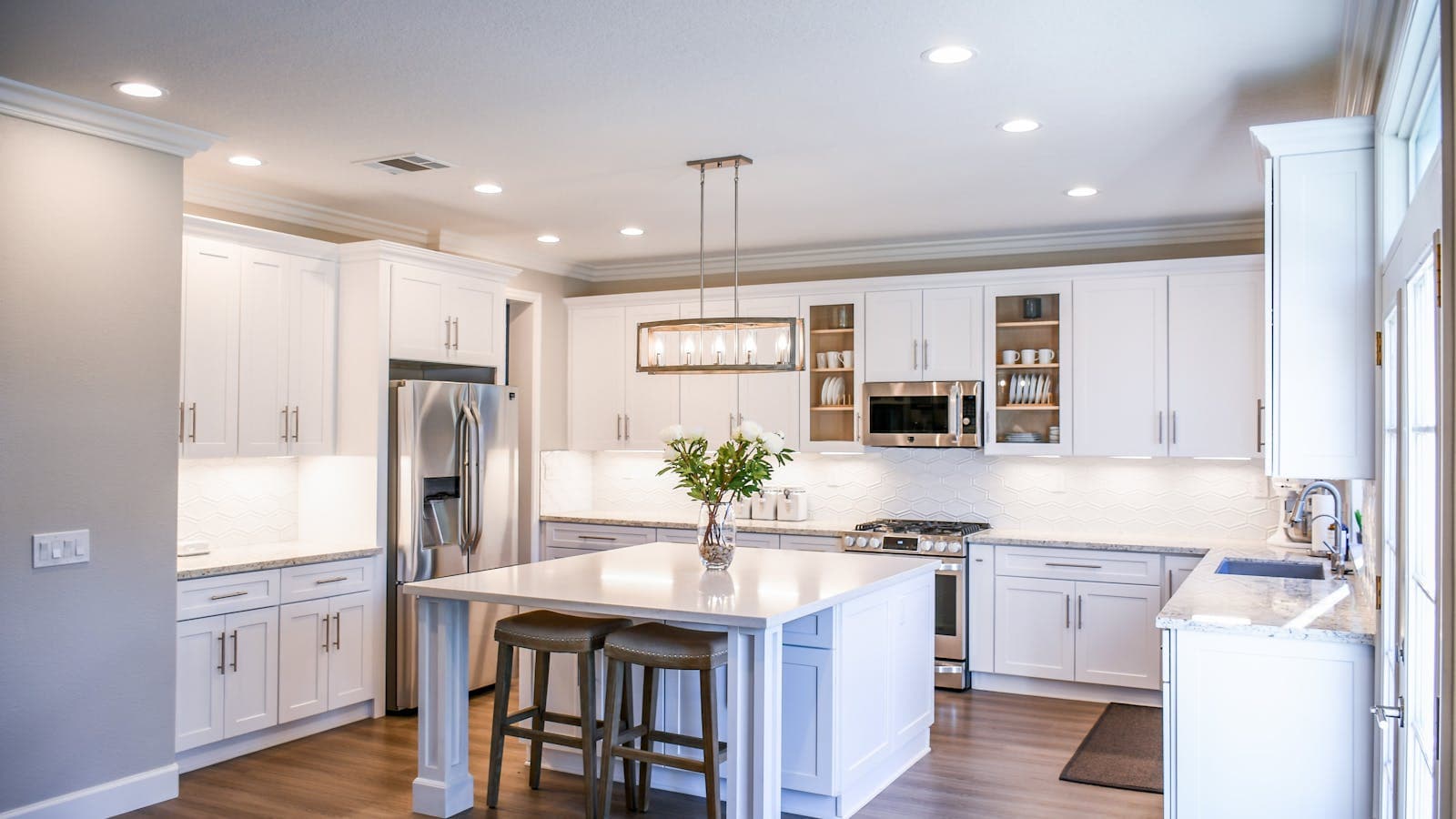
The best kitchen layout for a Vancouver, WA home is usually an L-shape with an island for kitchens over 170 square feet, a galley for tight footprints under 100 square feet, and a U-shape for larger square or rectangular rooms with one open side. That short answer is the right starting point — but the real decision depends on your home’s style, the size of the room, and how the kitchen connects to the rest of your living space. This guide walks through the four main kitchen layout ideas Vancouver WA homeowners actually use in 2026, with size minimums, cost ranges, work-triangle rules, and Clark County permit notes.
Plan Your Layout
Not sure which layout works in your space? GVX’s design team measures, sketches, and prices three options side-by-side for every Clark County kitchen project we take on.
Request a Free Layout ConsultationThe four kitchen layouts at a glance for Vancouver, WA homes
Almost every kitchen built in the last 75 years uses one of four base shapes. The right one for your Vancouver, WA remodel depends on the dimensions of the room, whether one side opens to a great room, and how many people cook at once. Here is the short comparison before we dig into each one.
| Layout | Best for | Min. footprint | Typical PNW use |
|---|---|---|---|
| Galley | Solo cooks, narrow rooms, condos | ~70 sq ft (7 ft × 10 ft) | Vancouver and Camas townhomes, mid-century ranches |
| L-shape | Open-concept living, two cooks | ~120 sq ft | Most modern Clark County remodels, ranches, and new builds |
| U-shape | Maximum storage and counter run | ~150 sq ft (10 ft × 15 ft) | Larger 1990s and 2000s Clark County homes |
| Island / peninsula | Entertaining, multiple cooks | ~170 sq ft (with 42″ clearances) | Kitchen-great-room remodels, PNW Modern new builds |
GVX has installed all four shapes across Vancouver, Washougal, Battle Ground, and Camas. The layout that works best for your home is rarely the trendiest one — it is the one that fits the dimensions you already have without forcing structural work that blows the budget. For a deeper look at total project pricing once a layout is locked in, see our kitchen remodel cost guide for Vancouver, WA.
The kitchen work triangle: still the rule worth keeping
Before choosing a shape, understand the work triangle. The triangle connects your sink, range, and refrigerator — the three points where you do most kitchen work. The National Kitchen and Bath Association (NKBA) recommends each leg measure between 4 and 9 feet, with a total perimeter of 13 to 26 feet. No leg should be obstructed by tall cabinets or major traffic.
Why it still matters in 2026: even with double ovens, prep sinks, and beverage centers becoming common in higher budgets, the sink-range-fridge triangle is what your body walks while cooking dinner on a Tuesday. A great-looking layout that ignores the triangle wears people out.
- Each leg 4–9 feet: short enough for efficiency, long enough that two appliances are not crammed together.
- Total perimeter 13–26 feet: longer than 26 feet means you walk too much; shorter than 13 feels cramped.
- No traffic crossing the triangle: dining aisles, doorways, and island walkways should pass outside it, not through it.
Pro tip from the GVX design team: in open-concept Pacific Northwest homes where the kitchen flows into a great room, place the sink along the open side so the cook faces the room while prepping. The range and refrigerator anchor the working walls behind.
Galley kitchen layout: the most efficient small footprint
A galley kitchen layout puts cabinets and appliances on two parallel walls with a corridor between them. It is the oldest and arguably most efficient layout — restaurant kitchens still use it. For Vancouver, WA homeowners with townhomes, condos, mid-century ranches, or small craftsman bungalows, a galley often delivers more storage and counter space than any other shape in the same square footage.
- Best when: the kitchen is a long, narrow rectangle and at least one end is open or has a doorway.
- Aisle width: 42 inches minimum between counters; 48 inches is the comfortable target if both sides have appliances.
- Work triangle: place the range and refrigerator on opposite walls and the sink under a window if possible. This produces the tightest, most efficient triangle of any layout.
Galley kitchens are common in older Vancouver homes built before 1990. The downside is poor flow with two cooks, and closed-off feel if both ends are walled. A common GVX remodel is to open one end of a galley into a dining or living space, which keeps the efficiency but improves sightlines.
What a galley remodel typically costs in Vancouver, WA
A cosmetic galley refresh (paint, hardware, countertops, appliances) runs $20,000 to $40,000. A full galley remodel with new cabinets, layout-preserving plumbing, and updated electrical lands in the $45,000 to $75,000 range for most Clark County homes. Opening one end into another room adds $8,000 to $20,000 depending on whether the wall is load-bearing.
L-shaped kitchen layout: the Vancouver, WA favorite
The L-shaped kitchen layout uses two adjacent perpendicular walls, leaving the other two sides of the room open. It is the single most popular layout in current Clark County remodels because it pairs naturally with open-concept living, supports an island when the room is large enough, and works in nearly every home style — from 1970s ranches to PNW Modern new builds.
- Best when: the kitchen sits in the corner of a larger room or opens to a dining or great room.
- Counter run: aim for 8–10 feet on the long leg and 6–8 feet on the short leg for a balanced layout.
- Work triangle: tuck the refrigerator at one end of the L, the range mid-wall, and the sink toward the other end. With an island added, the sink often moves to the island.
L-shape is also the layout that benefits most from adding a kitchen island. The two open sides give you room to place one without crowding traffic, and the island can carry prep, seating, or a second sink. For sizing, clearance, and pricing, our kitchen island cost guide for Vancouver, WA walks through every variable.
L-shape strengths and tradeoffs
| Strengths | Tradeoffs |
|---|---|
| Flexible — fits ranches, craftsman, modern | Less storage than a U-shape in same footprint |
| Works with or without an island | Corner cabinet always needs a smart solution |
| Pairs well with open-concept great rooms | Small Ls (under 80 sq ft) feel undersized vs. galleys |
| Two cooks can work without colliding | Work triangle gets long if room is too wide |
U-shaped kitchen layout: maximum counter and storage
A U-shaped kitchen wraps cabinets along three walls. It is the layout that gives you the most counter space and the most storage per square foot, and it creates a strong enclosed work zone that separates the cook from the rest of the house. U-shapes are common in Clark County homes built between 1990 and 2010 where kitchens were designed as closed rooms.
In 2026, most Vancouver, WA U-shape remodels involve removing one wall to open the kitchen into a dining or living room — converting a U into an open L with a peninsula or island. That said, a true U-shape still has a place in larger homes where the cook prefers a defined working zone and the room is wide enough to feel open.
- Best when: the kitchen is at least 10 feet by 15 feet and storage is a top priority.
- Aisle width: 48–60 inches between opposite legs of the U; less than that feels boxed in.
- Work triangle: one appliance per wall — sink in the middle facing into the room, range on one side, refrigerator on the other.
Pro tip: in older closed-off Vancouver U-shape kitchens, removing the upper cabinets on one wall and replacing the wall below with a peninsula often gives you 80% of the open-concept feel at 30% of the cost of removing the wall entirely. Our open floor plan remodel cost guide breaks down full wall-removal pricing for Clark County.
Island and peninsula layouts
Strictly speaking, an island or peninsula is not a standalone layout — it is an addition to one of the four base shapes. But because so many Vancouver, WA kitchen remodels are driven by “we want an island,” it is worth covering the layout rules separately.
An island works best inside an L-shape or U-shape where there is at least 42 inches of clearance on all sides — 48 inches is the GVX recommended minimum for kitchens with two cooks. That means a kitchen needs roughly 13 feet by 13 feet (170 square feet) before an island makes physical sense. Smaller rooms force the island too close to the perimeter cabinets and turn the work zone into a hallway.
- Standard island size: 4 feet by 7 feet is a common starting point, scalable up to 4 feet by 10 feet in larger Clark County kitchens.
- Seating: plan 24 inches of width per stool, with a 12-inch overhang for legroom.
- Plumbing or gas in the island: adds $2,500–$8,000 in trade work and triggers a Clark County permit.
- Peninsula: if the room is too small or too narrow for an island, a peninsula attached to one of the legs of an L gives you most of the seating and prep benefit without the clearance requirement.
How a kitchen island affects the work triangle
Adding an island typically reshapes the triangle. The most common approach in Clark County remodels is to relocate the sink (and sometimes the dishwasher) to the island, leaving the range and refrigerator on the perimeter walls. This produces a clean, open triangle where the cook faces the room. About 65% of GVX kitchen remodels with islands use this configuration.
One-wall kitchens for small Vancouver, WA homes
A one-wall kitchen puts every appliance and all cabinetry along a single wall. It is the simplest, cheapest layout to build and the layout you will most often see in studio apartments, ADUs, garage conversions, and small Pacific Northwest cottages. For homeowners building an ADU or finishing a basement apartment in Vancouver, WA, this is often the right choice.
- Footprint: needs only 10–14 feet of wall length; depth of 4–5 feet is enough.
- Work triangle: technically becomes a line, not a triangle — group the sink between the range and refrigerator, with at least 18 inches of counter between each.
- Best paired with: a small island or rolling cart for prep space, since one-wall layouts have limited continuous counter run.
PNW kitchen sizes: what actually fits Vancouver, WA homes
Layouts on Pinterest assume bigger rooms than most Clark County homes have. Knowing typical PNW kitchen sizes helps you set expectations before measuring. Based on GVX’s remodel files across Vancouver, Camas, Washougal, and Battle Ground, here are the kitchen footprints we see most often by home type.
| Home type | Typical kitchen size | Most common layouts |
|---|---|---|
| 1950s–1970s ranch (Vancouver) | 90–130 sq ft | Galley, small L-shape |
| 1980s–1990s split-level / two-story | 120–180 sq ft | L-shape, U-shape |
| 2000s–2010s Clark County build | 180–260 sq ft | L-shape with island, U-shape |
| 2015+ PNW Modern / new build | 220–380 sq ft | L-shape with island, double-island |
| Townhome / condo (Camas, downtown Vancouver) | 70–110 sq ft | Galley, one-wall |
| Detached ADU / DADU | 50–90 sq ft | One-wall, micro-galley |
These are the rooms — not the open-concept great rooms they may flow into. If your kitchen feels bigger than the numbers above, you are probably measuring the kitchen plus attached dining or living. For an island layout to work, the kitchen footprint itself needs to support it after walls are removed.
How much do kitchen layout changes cost in Vancouver, WA?
Layout changes are where kitchen budgets often get away from homeowners. Keeping the existing layout (cabinets, appliances, plumbing in the same locations) keeps costs predictable. Moving things adds real money and triggers permits. Here is what specific changes typically cost in Clark County in 2026.
| Layout change | Typical added cost | Permit required? |
|---|---|---|
| Same layout, new cabinets & counters | $0 added (baseline) | Usually no |
| Move sink to island (new plumbing) | $2,500–$5,500 | Yes |
| Relocate range (new gas/electric run) | $1,800–$4,500 | Yes |
| Add a new island with electrical only | $3,500–$8,000 | Yes (electrical) |
| Remove a non-load-bearing wall | $3,500–$7,500 | Yes |
| Remove a load-bearing wall (new beam) | $8,500–$22,000 | Yes (structural) |
| Convert galley into open L-shape | $10,000–$28,000 | Yes |
| Convert U-shape into L with peninsula | $6,500–$15,000 | Sometimes |
Keep in mind these are deltas on top of the base remodel. The Remodeling Magazine 2025 Cost vs. Value report puts a mid-range Pacific Northwest kitchen remodel at roughly $80,000 with a 75–85% return on resale, and a major remodel closer to $160,000 with a 55–65% return. For a full breakdown by tier, our Vancouver, WA kitchen remodel cost guide gives you the full picture.
Clark County permit notes for layout changes
Clark County and the City of Vancouver, WA require permits for most kitchen layout changes. The general rule: cosmetic swaps inside the existing footprint do not trigger a permit, while anything that moves utilities or changes structure does. These are the triggers most likely to apply to a layout change.
- Plumbing relocation (sink, dishwasher, icemaker line): plumbing permit required.
- New circuits or relocated outlets: electrical permit required, plus inspection.
- Gas line moves or additions: mechanical permit and pressure test.
- Wall removal (load-bearing): building permit with structural plans, often stamped by an engineer.
- New range hood vented to exterior:mechanical permit.
Permit fees for a kitchen layout change in Clark County generally run $500–$2,000 depending on valuation. GVX pulls and manages permits for every project we run, and our team coordinates inspections so the schedule does not stall mid-build. For more on what triggers permits and how the inspection process works, see our Vancouver, WA remodeling permits and inspections guide.
How to pick the right layout for your home
When the GVX team walks a kitchen for the first time, we ask the same five questions in this order. They almost always point to the right layout before we sketch anything.
- How big is the room, and is it a corner or a rectangle? A long narrow rectangle points to a galley. A corner room points to an L. A larger rectangle points to a U or L-with-island.
- How does the kitchen connect to the rest of the home? Open to a great room, dining, or hallway? Layouts that face the open side win.
- How many cooks and how often do you entertain? One cook can use any layout. Two cooks need 48-inch aisles, an island, or a U with wide legs.
- How much storage do you actually need? A U-shape has the most. An L-shape with a tall pantry can match it. A galley needs ceiling-height cabinets to keep up.
- What is your budget, and how willing are you to move utilities? Keeping the layout saves $8,000–$30,000 versus moving the sink, gas, or walls.
Once the layout is chosen, the timeline and permit path become predictable. For a week-by-week look at how a Clark County kitchen project actually unfolds, our Vancouver, WA kitchen remodel timeline walks through each phase.
A real Vancouver, WA layout decision
A Hazel Dell homeowner came to us last fall with a closed-off 1986 U-shape kitchen — about 130 square feet, with a half-wall separating the kitchen from a small dining nook. They wanted “an island.” After measuring, the room was too narrow for a true island and keep the U; clearances would have dropped to 32 inches. Instead, we removed the half-wall (non-load-bearing, $4,800), converted the U into an open L-shape, and added a 4-foot peninsula with two seats. Net cost of the layout change versus a same-footprint remodel: about $11,500. The result was the open kitchen they wanted at 40% less than the structural option.
Ready to Plan Your Layout?
The GVX team measures, sketches, and prices three layout options for every Clark County kitchen we take on — so you can see the tradeoffs before committing. Free, no obligation.
Schedule a Free ConsultationKitchen layout FAQ
What is the best kitchen layout for a small home?
For most Vancouver, WA homes under about 150 square feet of kitchen space, a galley or one-wall layout works best. Galley kitchens use both parallel walls efficiently and keep the work triangle compact. One-wall layouts free up the opposite side for casual dining, laundry stacking, or a small island.
Is a galley or L-shape kitchen better?
Galley kitchens are more efficient for one cook and tighter spaces, while L-shape kitchens are better for open-concept living and multiple cooks. In Clark County remodels, L-shape is the most common upgrade because it pairs naturally with islands and great rooms in mid-century and modern PNW homes. Galleys still win for rentals, ADUs, and long narrow rooms.
How much space do you need for a kitchen island?
Plan for at least 42 inches of clearance on all sides of the island, or 48 inches if more than one cook will use the kitchen at once. Most Vancouver, WA kitchens need a footprint of about 13 by 13 feet (around 170 square feet) before an island makes physical sense. Smaller rooms are often better served by a peninsula attached to one of the L’s legs.
What is the kitchen work triangle?
The kitchen work triangle is the path between the sink, range, and refrigerator. The National Kitchen and Bath Association recommends each leg measure between 4 and 9 feet, with a total perimeter of 13 to 26 feet, and no major traffic crossing the triangle. It remains the most reliable design check for functional kitchens in 2026.
Do kitchen layout changes require a permit in Clark County?
Yes, most do. Moving plumbing, gas lines, electrical circuits, or load-bearing walls all trigger Vancouver, WA and Clark County permits and inspections. Cosmetic swaps that keep the existing footprint usually do not require a permit. GVX handles all permitting for projects we manage.
Which kitchen layout has the best resale value in Vancouver, WA?
L-shape kitchens with an island are the strongest layout for resale right now, especially in Clark County homes built between 1970 and 2005 that originally had closed-off kitchens. Buyers consistently respond to open sightlines into living and dining, which is why this is our most requested layout change.
Can I add an island to a U-shape kitchen?
Only if the room is large enough — at least 12 feet between opposite legs of the U, with 42–48 inches of clearance once the island is in place. In smaller PNW U-shape kitchens, removing one leg and converting to an L-shape with island usually delivers a better result than forcing an island into a tight U.
Sources & references
- National Kitchen & Bath Association — Kitchen Design Guidelines (work triangle and clearance standards)
- Remodeling Magazine — 2025 Cost vs. Value Report, Pacific Northwest region
- Clark County Community Development — Building Permit Information for Kitchen Remodels
- City of Vancouver, WA — Permit Center, Residential Permits
- GVX Remodeling internal project records, Clark County kitchen remodels 2023–2026
Written by
GVX Remodeling Team
Practical kitchen layout and design guidance from the GVX Remodeling team, helping Clark County homeowners pick the right shape for their space, budget, and PNW lifestyle.