
How Much Does an Open Floor Plan Remodel Cost in Vancouver, WA?
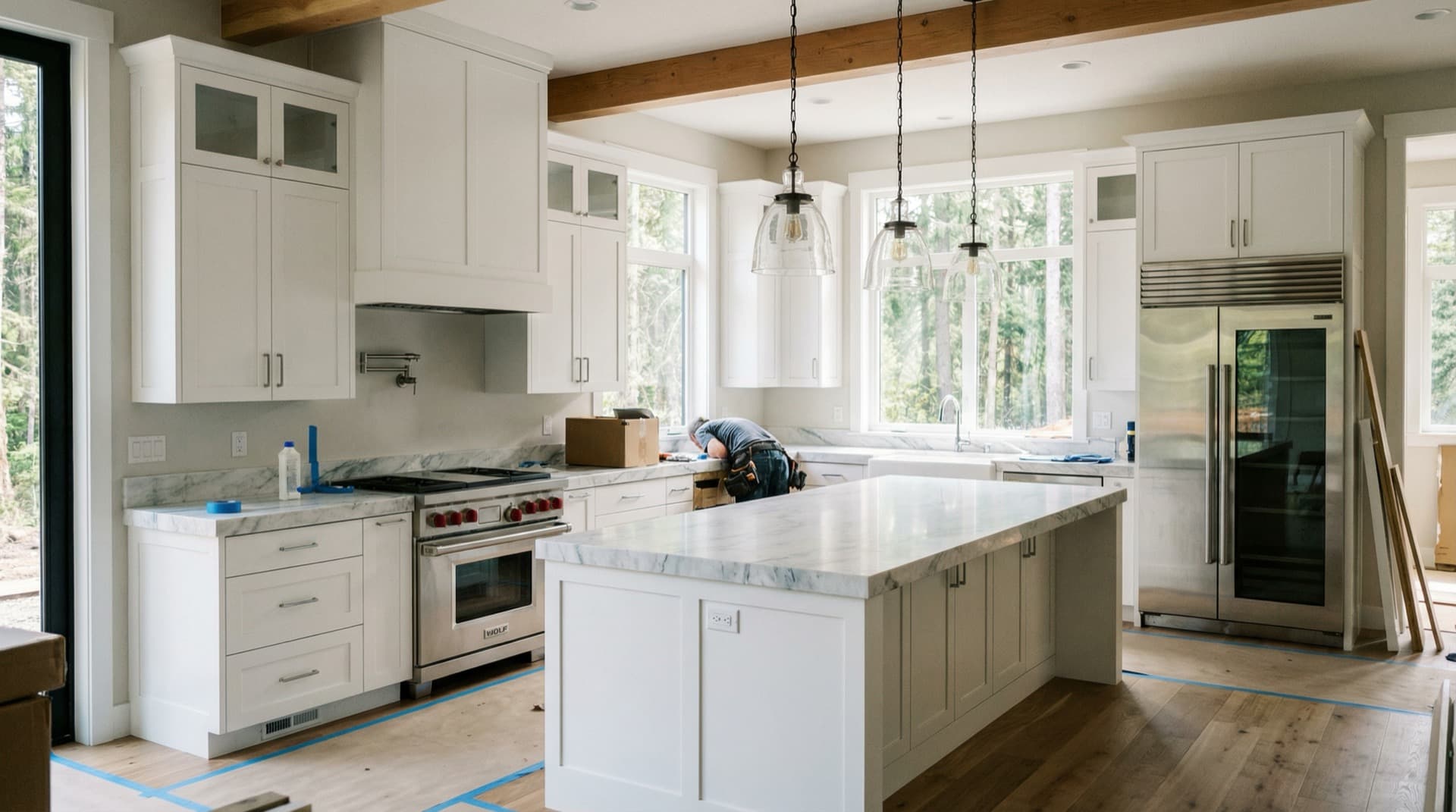
Opening up a floor plan is one of the most transformative remodels Vancouver, WA homeowners ask about — and one of the trickiest to price. A single wall removal can cost anywhere from $1,500 for a simple partition to $10,000 or more when load-bearing structure is involved (HomeAdvisor/Angi, 2025). Add HVAC rerouting, floor matching, and electrical relocation, and a full open concept conversion lands between $25,000 and $80,000 for most Clark County homes.
This guide breaks down every cost layer you'll encounter, from the structural engineer assessment through finishing work. You'll also see real timelines, permit requirements specific to Clark County, and the design trade-offs worth thinking about before you swing a sledgehammer.
TL;DR
Wall removal in Vancouver, WA runs $1,500–$10,000 depending on whether the wall is load-bearing. Full open floor plan conversions cost $25,000–$80,000 when you include HVAC, electrical, flooring, and finishing. Washington construction labor runs 25.5% above the national average (BLS, 2025), so national cost estimates almost always understate what you'll pay in Clark County.
If you're early in the process, start with our step-by-step remodel planning guide before getting into cost specifics.
How Much Does It Cost to Open Up a Floor Plan?
Removing a non-load-bearing wall in Vancouver, WA costs $1,500–$4,000, while load-bearing wall removal runs $4,000–$10,000 including beam installation (HomeAdvisor/Angi, 2025). Full open concept conversions that include structural, mechanical, and finish work land between $25,000 and $80,000 for most Clark County homes.
The price gap between a partition wall and a load-bearing wall is dramatic. A partition tear-out is mostly labor, drywall patching, and paint. A load-bearing removal requires a structural engineer, a temporary support system during construction, and a steel or laminated veneer lumber (LVL) beam sized to carry the transferred load.
| Scope | Cost Range | What's Included |
|---|---|---|
| Non-load-bearing wall removal | $1,500 – $4,000 | Demo, drywall patching, texture, paint, debris haul |
| Load-bearing wall removal | $4,000 – $10,000+ | Engineer plans, temp shoring, beam & post install, finish work |
| Structural engineer assessment | $100 – $500 | On-site evaluation, beam sizing, stamped drawings |
| Full open concept conversion | $25,000 – $80,000 | Structural, HVAC, electrical, plumbing, flooring, all finish |
Don't forget the structural engineer fee. At $100–$500 (Structural Engineers Association of Washington), it's one of the cheapest line items — and the one that prevents the most expensive mistakes.
Open Floor Plan Costs at a Glance
Sources: HomeAdvisor/Angi (2025), HVAC Contractors Alliance, NARI
How Do You Know If a Wall Is Load-Bearing?
Clark County requires engineer-stamped plans for any structural wall modification (Clark County Building). A structural engineer assessment runs $100–$500 and is the only reliable way to confirm whether a wall carries weight. Visual clues help, but they aren't enough to bet your home's structure on.
Common Signs a Wall Might Be Load-Bearing
- Runs perpendicular to floor joists. Walls that cross the joist direction are the most likely candidates for carrying structure.
- Sits directly on the foundation or a beam below. If you can see in the basement or crawlspace that a wall lines up over a concrete wall or support beam, it's almost certainly load-bearing.
- Supports an upper floor, attic, or roof structure. Any wall beneath a second story is suspect until proven otherwise.
- Located near the center of the house. Central walls in ranch-style homes — common throughout Clark County — often carry the ridge or ceiling joists.
Why You Should Never Guess
We've seen what happens when homeowners skip the engineer. One Salmon Creek family removed what they assumed was a partition wall between their kitchen and dining room. Within 48 hours, the ceiling showed visible sag, drywall cracked along the second-floor hallway, and a door upstairs wouldn't close. The emergency repair — temporary shoring, engineer assessment, steel beam retrofit, drywall repair, and paint — cost over $15,000. The original wall removal would have been about $6,000 if they'd hired an engineer and contractor from the start.
That $100–$500 engineer fee? It's insurance against a five-figure mistake. Every time.
What Are the Hidden Costs of Opening Up a Floor Plan?
Floor matching and leveling is the most common unexpected cost in wall removal projects, according to the National Association of the Remodeling Industry (NARI). When a wall comes out, the gap left in the flooring must be filled — and matching old hardwood or tile with new material is rarely straightforward, running $2,000–$8,000.
HVAC Rerouting: $2,000–$5,000
Walls hide ductwork. When that wall goes away, the ducts need a new path. The HVAC Contractors Alliance reports rerouting averages $2,000–$5,000 depending on the number of runs affected. Homes with floor registers in the removed wall tend to cost more because the new routing often runs through the floor system.
Electrical and Plumbing Relocation: $1,500–$4,000
Outlets, switches, and light fixtures inside the wall need new locations. If the wall contains a plumbing vent stack — not uncommon when kitchen and bathroom share a wall — expect the higher end of this range. Plumbing vent rerouting alone can run $1,500–$2,500.
Floor Matching and Leveling: $2,000–$8,000
This is the big one. You've got a 4-inch gap in the floor where the wall sat, and the rooms on each side might have different flooring materials entirely. Matching existing hardwood to new stock requires sanding and refinishing the entire visible area. For homes with different flooring in each room, full replacement is often more cost-effective than patching. Check our best flooring for PNW homes guide for material options.
Drywall, Texture, and Paint: $1,500–$3,000
The ceiling where the wall met overhead needs patching, and matching existing texture (orange peel, knockdown, smooth) is trickier than it looks. Most homeowners end up repainting the entire connected space for a consistent finish.
Where Hidden Costs Go (Typical Distribution)
Based on NARI remodeling cost data and HVAC Contractors Alliance averages
What Does the Remodel Process Look Like Step by Step?
A full open concept conversion in Clark County takes 6–12 weeks from permit approval to final inspection, with an additional 2–4 weeks for permit processing upfront (Clark County Building, 2026). Here's what each phase looks like.
Step 1: Structural Engineer Assessment (Week 1)
The engineer visits, identifies load paths, and produces stamped drawings showing beam sizes and post locations. This document is required for your permit application. Budget $100–$500 and allow 1–2 weeks for the report.
Step 2: Design and Planning (Weeks 1–2)
Your contractor or designer creates a scope of work that includes structural, mechanical, electrical, and finish details. This is where you decide on flooring transitions, lighting placement, and whether a kitchen island will replace the removed wall as a visual divider.
Step 3: Clark County Permits (Weeks 3–6)
Submit your engineer-stamped plans to Clark County Community Development. Residential structural permits typically process in 2–4 weeks. Your contractor can order materials during this window so nothing delays the start.
Step 4: Demo and Structural Work (Weeks 7–8)
Temporary shoring goes up first. The wall comes down, and the new beam and posts are installed. This phase moves fast — usually 3–5 days for a single wall. Structural inspection happens before anything gets closed up.
Step 5: Mechanical Rerouting (Weeks 8–10)
HVAC, electrical, and plumbing get relocated. Each trade works in sequence, followed by rough inspections. Allow 1–2 weeks depending on how much ductwork and wiring lived inside the removed wall.
Step 6: Finishing (Weeks 10–14)
Drywall patching, floor repair or replacement, texture matching, paint, trim, and final inspections. This phase takes 2–4 weeks. The flooring portion usually eats the most time, especially if you're refinishing existing hardwood to match new sections.
Typical Project Timeline (Weeks)
Total elapsed time: 6–12 weeks after permit approval. Source: Clark County Building
What's the biggest timeline risk? Permit delays and floor refinishing. If your floor needs a full sand-and-finish across the merged space, add 5–7 days of cure time where no one walks on the surface.
Is an Open Floor Plan Right for Your Home?
Open floor plans remain the number-one buyer preference for new construction, according to the National Association of Home Builders (NAHB). But “popular” doesn't mean universally right. The decision depends on your household, your home's structure, and how you actually use the space day to day.
Pros of Opening Up
- More natural light flows through the space — especially valuable during the PNW's grey winter months
- Better traffic flow for entertaining and family interaction
- Sight lines from kitchen to living area let you cook while watching kids
- Modern aesthetic that aligns with current buyer preferences
Cons to Consider
- Less privacy — noise, cooking smells, and clutter carry across the entire space
- Fewer wall surfaces for furniture, shelving, and art
- Heating efficiency can change when rooms merge into one large volume
- Kitchen messes are always visible from the living room
The Partial Open Plan Compromise
Here's something we've noticed across dozens of Clark County projects: families with school-age kids increasingly choose a partial open plan over a full one. One Camas family with three kids wanted the kitchen open to the living room but kept the breakfast nook wall intact. It gave them a contained homework zone 15 feet from the stove — visible but acoustically separate. The partial approach also saved about $12,000 because only one wall needed structural work instead of two.
Not every wall needs to go. Removing the right wall matters more than removing the most walls. Start with our remodel planning guide to map out priorities before committing.
What Are Popular Open Floor Plan Layouts for Vancouver, WA Homes?
Ranch-style homes make up a significant share of Clark County's housing stock, and the kitchen-to-living-room wall removal is far and away the most requested open concept project we see. Washington State construction labor costs sit 25.5% above the national average (BLS, 2025), so choosing the right layout saves real money.
Ranch-Style Kitchen-to-Living Room Opening
The classic Clark County project. Remove the wall between kitchen and living room, install a beam, and you've got a combined space that feels twice as large. This layout typically runs $25,000–$50,000 for the full conversion including all finish work. Most ranch homes were built with the kitchen walled off from the main living area, so the transformation is dramatic.
Two-Story First-Floor Flow
In two-story homes, the first-floor walls between kitchen, dining, and family room can often be opened while leaving the second floor completely untouched. This works well because the upper floor's load paths can usually be consolidated into fewer posts. Expect $35,000–$65,000 depending on how many walls come down and how much mechanical rerouting is needed.
Kitchen Island as Room Divider
The most popular design element in open floor plan remodels. After removing the wall, a 7–to-9-foot island replaces it as a visual separator between kitchen and living space. It provides counter seating, storage, and a prep surface without blocking sight lines. See our 2026 kitchen trends for more on island design. And if you're budgeting the kitchen portion separately, check our kitchen remodel cost guide.
Half-Wall and Breakfast Bar Compromise
Don't want to remove the entire wall? A half-wall or breakfast bar preserves some definition between rooms while still opening up sight lines and light flow. This approach costs significantly less — typically $3,000–$8,000 — because you avoid the full structural beam in many cases. It's a smart option when the wall is load-bearing and the beam cost alone would eat most of your budget.
Layout Popularity in Clark County Projects
Based on GVX Remodeling project data, 2024–2026
How Much Value Does an Open Floor Plan Add?
Open layouts rank among the top five features home buyers seek, according to the National Association of Realtors (NAR, 2024). Wall removal with quality finishing work typically recoups 50–70% of the project cost at resale. When paired with a kitchen remodel, that ROI can climb to 70–80%.
Why does the combined approach perform better? Buyers see the open kitchen-living space as a single feature, not separate line items. A minor kitchen remodel in the Pacific region already recoups 96.1% of cost on its own (Remodeling Magazine, 2025). Add the open layout, and the combined project becomes one of the strongest remodeling ROI plays available to Clark County homeowners.
When Open Concept Hurts Resale
Not every opening adds value. Removing a wall that eliminates a bedroom — even if it was a small one — can reduce your home's bedroom count and hurt the listing. Similarly, over-opening a home in a neighborhood where buyers expect traditional layouts can make your property the outlier. Match the renovation to what comparable homes in your neighborhood look like.
If you're thinking about financing your project, keep in mind that lenders consider post-renovation appraisal value. An open concept conversion that pushes your home's value above the neighborhood ceiling won't appraise as high as you'd expect.
Want to Know What Your Project Would Cost?
We'll walk through your space, identify load-bearing walls, and give you a clear cost range for opening up your floor plan — free, no pressure.
Schedule a Free ConsultationFrequently Asked Questions
Do I need a permit to remove a wall in Vancouver, WA?
Yes, for load-bearing walls. Clark County requires engineer-stamped plans and a building permit for any structural modification. Non-load-bearing partition walls may not need a permit, but check with Clark County Building before starting work. Skipping a required permit can cause problems when you sell the home — title companies and buyers' inspectors flag unpermitted structural changes. Read our permits and inspections guide for the full process.
How long does an open floor plan remodel take?
Six to twelve weeks for most projects once permits are approved, with 2–4 weeks of permit processing time upfront. Smaller projects — a single non-load-bearing wall — can wrap up in 2–3 weeks. Larger multi-wall conversions with full kitchen work can stretch to 16 weeks. The flooring and finishing phase usually takes the longest.
Can I remove a wall in a manufactured home?
It's possible but requires specialized engineering. Manufactured homes use HUD-code framing systems that differ from site-built construction. Standard beam calculations don't apply. You need an engineer experienced with manufactured housing, and the permitting process may involve the state Department of Labor & Industries rather than Clark County alone.
What's the difference between load-bearing and partition walls?
Load-bearing walls transfer weight from the roof, upper floors, or attic structure down to the foundation. They're part of the home's structural skeleton. Partition walls exist only to divide space and carry zero structural load. Removing a partition is straightforward demo and patch work. Removing a load-bearing wall requires an engineered beam, posts, and proper connections — plus permits and inspections.
Sources & References
- HomeAdvisor/Angi — Wall Removal Cost Guide (2025)
- Structural Engineers Association of Washington — Fee Ranges
- NAHB — What Home Buyers Really Want
- Clark County Community Development — Building Permits
- Bureau of Labor Statistics — WA Construction Labor Costs (2025)
- NARI — National Association of the Remodeling Industry
- NAR — 2024 Home Buyers and Sellers Generational Trends
- Remodeling Magazine — 2025 Cost vs. Value Report (Pacific Region)
- HVAC Contractors Alliance (ACCA) — Ductwork Rerouting Averages
Written by
GVX Remodeling Team
Practical cost and planning guidance from the GVX Remodeling team, helping Clark County homeowners make informed decisions about open concept conversions and structural remodeling.