Spa Bathroom Remodel in Vancouver, WA: Design, Wellness Features & Planning Guide (2026)
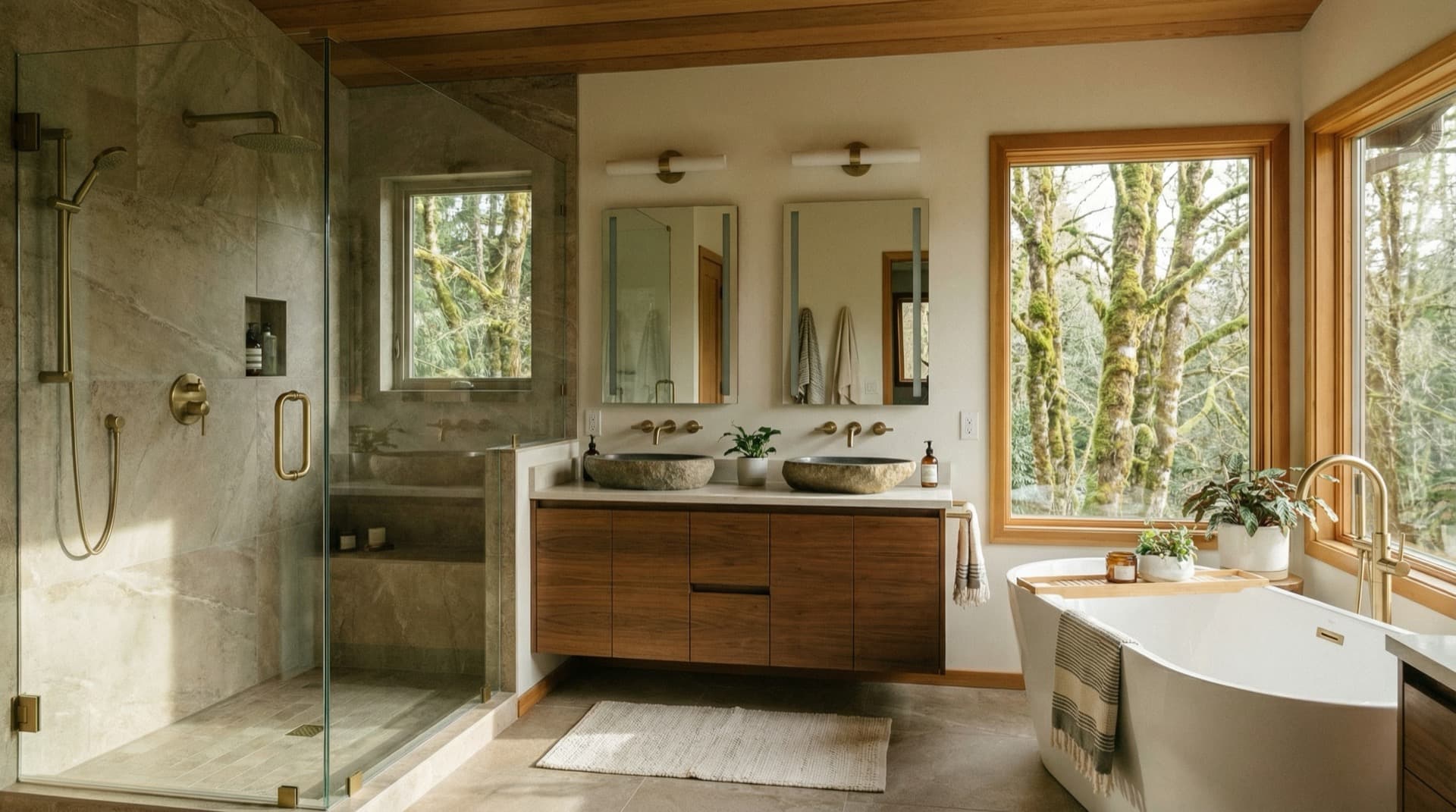
Spa-inspired bathrooms aren't a trend that's fading — they're becoming the baseline. The NKBA 2026 Design Trends Report found that 77% of kitchen and bath designers now see hotel-inspired spa features as a standard client request, not a luxury add-on. For Vancouver, WA homeowners navigating 150+ days of rain every year, a bathroom that doubles as a personal retreat makes practical sense.
This guide walks through how to design a spa bathroom remodel from concept to completion. You'll find layout strategies, wellness zone planning, material choices built for the Pacific Northwest climate, and realistic cost expectations. Whether you're planning a full master bath remodel or adding a few wellness upgrades to your next bathroom renovation, the framework here applies.
Get a Spa Bathroom Design Consultation
Ready to turn your bathroom into a personal retreat? Our team provides free, no-pressure design consultations for spa bathroom remodeling across Clark County.
Request a Free ConsultationKey Takeaways
- Spa features are mainstream: 77% of design professionals say hotel-inspired bathroom features are now standard requests (NKBA 2026)
- Most impactful upgrades: Heated floors (54%), steam showers (44%), and multi-function showers (43%) lead designer recommendations (Fixr 2026)
- Wellness adoption rising: 36% of renovated bathrooms include at least one wellness feature, up from roughly 20% in 2020 (Houzz 2025)
- Cost range: $25,000–$75,000 for a full spa bathroom remodel; budget spa add-ons start at $3,000–$8,000
- Pacific region ROI: Midrange bathroom remodels return 87.7% in the Pacific region (Remodeling Magazine, 2025)
Why Spa Bathroom Design Is the New Standard
One in three renovated bathrooms now includes at least one wellness feature, according to the Houzz 2025 Bathroom Trends Study. That 36% adoption rate has nearly doubled since 2020. The shift isn't just about aesthetics — it's about how people use their bathrooms after several years of prioritizing home-based wellness.
The global wellness economy hit $6.3 trillion in 2023 and continues growing at 8–10% annually, per the Global Wellness Institute. Bathrooms are one of the fastest-growing categories within that economy. Homeowners are applying the same logic they use for gym memberships and meditation apps to the rooms where they start and end each day.
In Clark County specifically, three factors are accelerating the trend:
- Climate demand: Vancouver, WA averages 150+ days of precipitation annually (NOAA). Heated floors and steam showers feel like practical upgrades, not indulgences, from October through April.
- Renovation over relocation: Most Washington homeowners hold sub-5% mortgage rates. With the Vancouver-area median home price near $549,000 (Redfin, 2025), improving the current home beats the cost of buying new.
- Buyer expectations: In the $500K+ market segment, spa-quality master baths are increasingly expected, not aspirational. Homes without them face a competitive disadvantage.
So, how do you actually design a spa bathroom that works in a Pacific Northwest home? It starts with understanding zones.
How to Plan Wellness Zones in Your Bathroom Layout
Roughly 75% of NKBA designers expect master bathroom square footage to increase in 2026 projects, driven largely by demand for separate functional zones (NKBA 2026). A well-designed spa bathroom organizes space into distinct areas, each serving a different purpose. This zone-based approach is what separates a bathroom with nice fixtures from one that genuinely feels like a spa.
The cleansing zone
This is your shower and/or tub area — the primary wet zone. In spa design, it gets the most attention because it's where you spend the most active time. A walk-in shower with a rainfall head, handheld wand, and bench seating is the 2026 standard. Steam functionality, body jets, and chromotherapy lighting all live in this zone.
For layout, position the cleansing zone against an exterior wall when possible. This simplifies plumbing rough-in and makes waterproofing more straightforward. If you're including a freestanding soaking tub, it typically sits adjacent to but separate from the shower — not inside it. For feature-by-feature costs, see our master bathroom spa remodel features and cost guide.
The grooming zone
Your vanity area handles daily tasks: brushing teeth, skincare, shaving, makeup. In a spa-inspired design, this zone prioritizes good lighting and clean sightlines. A floating vanity is the most common choice in 2026 spa bathrooms because it opens floor space and creates a lighter visual feel.
Task lighting matters here more than anywhere else. Backlit mirrors or vertical sconces on both sides of the mirror eliminate shadows on the face. Avoid overhead-only lighting in this zone — it creates harsh shadows that work against the spa atmosphere.
The relaxation zone
Not every bathroom has space for this, but larger master baths can include a dedicated area for drying off, applying products, or simply sitting. A built-in bench, a window seat, or even an upholstered stool near the tub serves this purpose. This is where ambient lighting and sound systems have the most impact.
The transition zone
The entry and toilet area should feel visually distinct from the spa elements. A water closet with a privacy partition or door keeps utility functions separated from the wellness experience. Heated floors in this zone still make sense — but design focus here is about practical storage and clean lines rather than atmosphere.
Which Spa Features Deliver the Most Impact?
The Fixr 2026 Design Trends survey polled design professionals on the features they recommend most. Heated floors topped the list at 54%, followed by steam showers at 44% and multi-function shower systems at 43%. Here's how each feature contributes to a spa experience — and which combinations work best.
Heated floors: the foundation of comfort
Electric radiant mats cost $500–$2,800 installed for a typical bathroom (Block Renovation, 2026). They rank first for a reason: warm feet on cold PNW mornings transform the daily experience. The mats add only 1/8 inch of height beneath tile or stone and draw 8–12 watts per square foot — roughly $15–$40 per month on your Clark County electric bill.
Heated floors also reduce moisture on tile surfaces, which matters in a region where ambient humidity runs high eight months of the year. Program them to warm up 30 minutes before your alarm and you won't want to go back.
Steam shower: therapeutic heat on demand
A steam shower generator costs $2,800–$10,000 installed (Angi, 2026). The generator itself is compact — about the size of a briefcase — and mounts inside a vanity cabinet or utility closet. What matters most is the enclosure: it needs to be fully sealed with a sloped ceiling to prevent dripping, and built with non-porous materials like porcelain or natural stone.
In the Pacific Northwest, vapor barriers behind steam shower walls are critical. Our ambient humidity is already high, so the waterproofing system needs to be airtight. Adding steam during an existing shower remodel is significantly cheaper than retrofitting later.
Multi-function shower systems
A ceiling-mount rainfall head, handheld wand, and body jets with a digital mixing valve run $1,500–$5,000 installed. These systems let you save temperature and pressure presets — one profile for a quick morning wake-up, another for a slow evening wind-down. You'll need a minimum 3/4-inch supply line; many older Vancouver homes run 1/2-inch.
Chromotherapy and ambient lighting
LED lighting embedded in shower walls, tub surrounds, or recessed ceiling fixtures costs $500–$3,000 installed. Blue tones promote relaxation, warm amber mimics candlelight, and programmable cycles transition through colors. Pair this with dimmer switches on all overhead lighting for full atmosphere control.
Freestanding soaking tub
Freestanding tubs appear in 18% of renovated bathrooms (Houzz, 2025) and cost $4,000–$10,000+ installed (This Old House, 2026). They serve as both a wellness feature and a visual centerpiece. Japanese-style deep soaking tubs have surged in popularity for their full-immersion design and smaller footprint.
Want to See These Features in Person?
We'll walk you through material samples, layout options, and realistic budgets for your spa bathroom — no pressure, no obligation.
Request a Free EstimateSpa Bathroom Materials for the Pacific Northwest
Material selection in the PNW carries different stakes than in a dry climate. Vancouver receives precipitation on 150+ days per year (NOAA, 2025), and daily shower steam compounds the moisture load. The NKBA 2026 report found that 91% of homeowners rank durability as their top selection criterion — and that priority is even more justified in our climate.
Tile and stone
Porcelain tile remains the go-to for spa bathroom floors and shower walls. It's impervious to moisture, compatible with radiant heating, and available in large formats (24x48 and bigger) that reduce grout lines for a cleaner look. Natural stone — marble, travertine, slate — adds warmth and character but requires annual sealing in the PNW humidity.
For shower floors specifically, choose a textured finish or small-format mosaic with adequate grout coverage. Large-format slabs look stunning but can be slippery when wet. Penny round or hexagonal mosaics provide both grip and a classic spa aesthetic.
Cabinetry and vanities
MDF-core vanities are a moisture risk in Clark County bathrooms. Plywood construction with marine-grade or exterior-grade panels is the better investment, adding only $50–$150 per unit. Wood-faced floating vanities in white oak, walnut, or teak are the dominant 2026 design trend — 62% of designers specify them (NKBA 2026). See our floating vanity cost guide for detailed pricing by tier.
Waterproofing systems
Every spa bathroom needs a continuous waterproofing membrane behind tile in wet areas. Systems like Schluter DITRA or Laticrete Hydro Ban create a bonded waterproof layer that protects wall framing and subfloor from moisture intrusion. This is non-negotiable in the PNW — we've seen too many bathrooms where skipping this step led to mold and structural damage within five years.
Ventilation
Washington State code requires a bathroom exhaust fan vented to the exterior. For spa bathrooms with steam showers, spec a fan rated for at least 1 CFM per square foot. Humidity-sensing models activate automatically and run until moisture drops to safe levels. Undersized or poorly ducted fans accelerate damage to every surface in the room — tile grout, cabinetry, and paint. For more on how ventilation systems affect material longevity, see our energy-efficient remodeling guide.
Design Principles That Make a Bathroom Feel Like a Spa
The NKBA 2026 report identifies “organic modern” and “transitional” as the two dominant bathroom design directions in 2026. Both lend themselves to spa atmospheres. But fixtures alone don't create the feeling. These design principles do.
Limit the material palette
Commercial spas use two to three materials, max. A residential spa bathroom should follow the same discipline. Pick one primary surface (e.g., large-format porcelain), one accent material (natural stone or wood), and one metal finish for all hardware. More than that and the space feels busy, which is the opposite of calm.
Maximize natural light
If your bathroom has a window, design around it. Frosted glass, textured glass, or a high transom window brings in PNW daylight without sacrificing privacy. Skylights and sun tunnels are worth the investment in north-facing bathrooms that would otherwise depend entirely on artificial light. Natural light is the single biggest factor in whether a bathroom feels like a spa or a clinical space.
Layer the lighting
Spa bathrooms need at least three lighting layers: ambient (recessed ceiling or cove lighting), task (vanity sconces or backlit mirror), and accent (under-vanity LEDs, niche lighting in the shower, chromotherapy). Put everything on dimmers or smart controls so you can shift from bright grooming mode to low relaxation mode.
Reduce visual clutter
Recessed niches in the shower replace hanging caddies. Inset medicine cabinets replace surface-mounted mirrors. Drawer organizers inside the vanity replace countertop bottles. Every visible item in a spa bathroom should be intentional. The goal is to create a space where you see surfaces and light — not stuff.
Warm the color temperature
Cool-white LEDs (5000K+) belong in operating rooms, not spa bathrooms. Spec 2700K–3000K for ambient and accent lighting. Warmer tones make natural stone and wood look richer, make skin look healthier in the mirror, and set a calmer mood. This single change costs almost nothing and makes a dramatic difference.
What Does a Spa Bathroom Remodel Cost in Vancouver, WA?
A midrange bathroom remodel in the Pacific region costs approximately $27,164 and returns 87.7% at resale, according to the 2025 Cost vs. Value Report. Spa features add $3,000–$30,000+ to that baseline depending on scope. Here's how the cost tiers break down for Vancouver-area spa bathroom projects.
Budget spa upgrade: $3,000–$8,000
Add heated floor mats ($500–$2,800), a rainfall showerhead ($200–$800), and basic chromotherapy lighting ($500–$1,500) to an existing bathroom. This tier works when the layout and fixtures are in good condition and you want a spa feeling without a full gut remodel.
Mid-range spa remodel: $25,000–$50,000
A full redesign with new tile, a walk-in shower with multi-head system, heated floors, a floating vanity, and upgraded lighting. This is the most common tier we see in Clark County. It covers all the core spa elements without exotic materials or extreme customization.
Luxury spa build: $50,000–$80,000+
Steam shower, freestanding soaking tub, natural stone surfaces, custom cabinetry, smart fixtures with digital controls, and a full sound system. Projects in this tier often involve structural changes — expanding the bathroom footprint, relocating plumbing, or adding a skylight. For a detailed breakdown of bathroom remodel costs by scope, see our bathroom remodel cost guide for Vancouver, WA.
Need financing options? Our home remodel financing guide compares HELOCs, home equity loans, and other options available to Clark County homeowners.
Spa Bathroom Remodel Cost Tiers — Vancouver, WA (2026)
Sources: HomeGuide, This Old House, Remodeling Magazine CVV 2025
Step-by-Step Spa Bathroom Remodel Planning
The NAHB 2025 Remodeling Market Index shows bathroom remodeling as the most commonly performed home renovation project nationally. That means contractors are busy, lead times are long, and planning ahead pays off. Here's the typical timeline for a spa bathroom remodel in Clark County.
Phase 1: Design and planning (4–8 weeks)
Start with your wish list, then map it against your budget and bathroom footprint. Decide on zones, primary features, and material direction before requesting contractor bids. Get at least three detailed estimates. Our guide to choosing a remodeling contractor covers the vetting process in detail.
Phase 2: Permitting (1–3 weeks)
Any project involving plumbing relocation, new electrical circuits, or structural changes requires a permit in Clark County. Permit fees run $85–$250 for plumbing or electrical work. A full walkthrough of the process is in our Vancouver, WA permits and inspections guide.
Phase 3: Demolition and rough-in (1–2 weeks)
Existing fixtures come out. Plumbing and electrical rough-in happens for new fixture locations, steam generators, heated floor connections, and any added circuits. The subfloor and wall framing are inspected for moisture damage — a common finding in older Clark County homes.
Phase 4: Waterproofing and tile (2–4 weeks)
Waterproofing membranes go down before any tile. Heated floor mats install on top of the membrane, beneath the tile. Shower walls, floors, and niches get tiled. This is the most time-intensive phase, especially with large-format or natural stone tile that requires precise layout.
Phase 5: Fixtures and finish (1–2 weeks)
Vanity installation, shower glass, mirrors, lighting fixtures, toilet, and trim work. Steam generator hookup and testing. Final plumbing and electrical connections. Everything gets tested before the final walkthrough.
Phase 6: Inspection and punch list (3–5 days)
Clark County inspectors verify plumbing, electrical, and any structural work. A punch list addresses minor items — caulk touch-ups, hardware adjustments, grout sealing. Total timeline: 8–14 weeks from demolition to completion, with the planning phase adding 4–8 weeks on the front end.
Do Spa Bathrooms Pay Off at Resale?
A midrange bathroom remodel returns 73.7% nationally and 87.7% in the Pacific region, per the 2025 Cost vs. Value Report. That Pacific region number is among the highest in the country, driven by strong housing demand in the Portland–Vancouver metro. Spa features contribute to that return by positioning your home competitively in a market where buyers increasingly expect them.
The NAR 2024 Remodeling Impact Report found that bathroom remodeling ranked among the top three projects for both cost recovery and homeowner satisfaction. Sellers who completed bathroom renovations reported a strong emotional uplift alongside the financial return — which makes sense for a room used every day.
Does that mean you should spend $80,000 on a spa bathroom in a $400,000 home? No. The NKBA recommends spending 5–10% of your home's value on a bathroom remodel. For the Vancouver-area median of $549,000, that's $27,000–$55,000. Stay in that range and you're positioned for strong recovery. For a broader look at which renovations deliver the best payback, see our best home renovation ROI guide.
If accessibility is a priority now or in the future, spa features overlap naturally with aging-in-place design. Walk-in showers, grab bars, curbless entries, and adjustable-height vanities serve both wellness and accessibility goals. Building them in during a spa remodel adds minimal cost compared to retrofitting later.
Ready to Design Your Spa Bathroom?
We'll walk through your layout, feature priorities, and budget to create a realistic plan for your spa bathroom remodel — free, no obligation.
Schedule a Free ConsultationFrequently Asked Questions
How much does a spa bathroom remodel cost in Vancouver, WA?
A full spa bathroom remodel costs $25,000–$75,000 depending on features and finishes. Budget spa upgrades — heated floors, a rainfall showerhead, and LED lighting — can be added to an existing bathroom for $3,000–$8,000. Luxury builds with steam showers, freestanding tubs, and smart fixtures exceed $80,000.
What are the most popular spa bathroom features in 2026?
Heated floors (54% of designer recommendations), steam showers (44%), and multi-function shower systems (43%) lead the Fixr 2026 Design Trends survey. Freestanding soaking tubs, chromotherapy lighting, and built-in sound systems round out the most requested features.
Does a spa bathroom remodel increase home value?
Yes. Midrange bathroom remodels return 73.7% nationally and 87.7% in the Pacific region (Cost vs. Value 2025). In Clark County's $500K+ housing market, spa features are becoming a competitive expectation rather than a premium add-on.
How long does a spa bathroom remodel take?
Plan for 8–14 weeks of construction, with 4–8 weeks of design and planning on the front end. Projects involving structural changes or custom materials trend toward the longer end. See our permits and inspections guide for the Clark County timeline.
Do I need special ventilation for a spa bathroom in the PNW?
Yes. Washington code requires an exhaust fan vented to the exterior. For spa bathrooms with steam showers, specify a fan rated for at least 1 CFM per square foot. Humidity-sensing models are strongly recommended in the Pacific Northwest. Undersized ventilation leads to mold and premature material failure.
Sources & References
- NKBA — 2026 Design Trends Report
- Houzz — 2025 Bathroom Trends Study
- Fixr — 2026 Bathroom Design Trends Survey
- Remodeling Magazine — 2025 Cost vs. Value Report (Pacific Region)
- Global Wellness Institute — Global Wellness Economy Monitor (2023)
- NAR — 2024 Remodeling Impact Report
- NAHB — 2025 Remodeling Market Index
- Angi — Steam Shower Cost Guide (2026)
- Block Renovation — Heated Bathroom Floor Cost (2026)
- This Old House — Freestanding Tub Cost (2026)
- NOAA — Portland/Vancouver Climate Data (2025)
- Redfin — Vancouver, WA Housing Market (2025)
Written by
GVX Remodeling Team
Practical spa bathroom design and remodeling guidance from the GVX Remodeling team, helping Clark County homeowners create wellness-focused spaces that last.