
EV Charger Installation During a Remodel: Cost and Planning Guide for Vancouver, WA (2026)
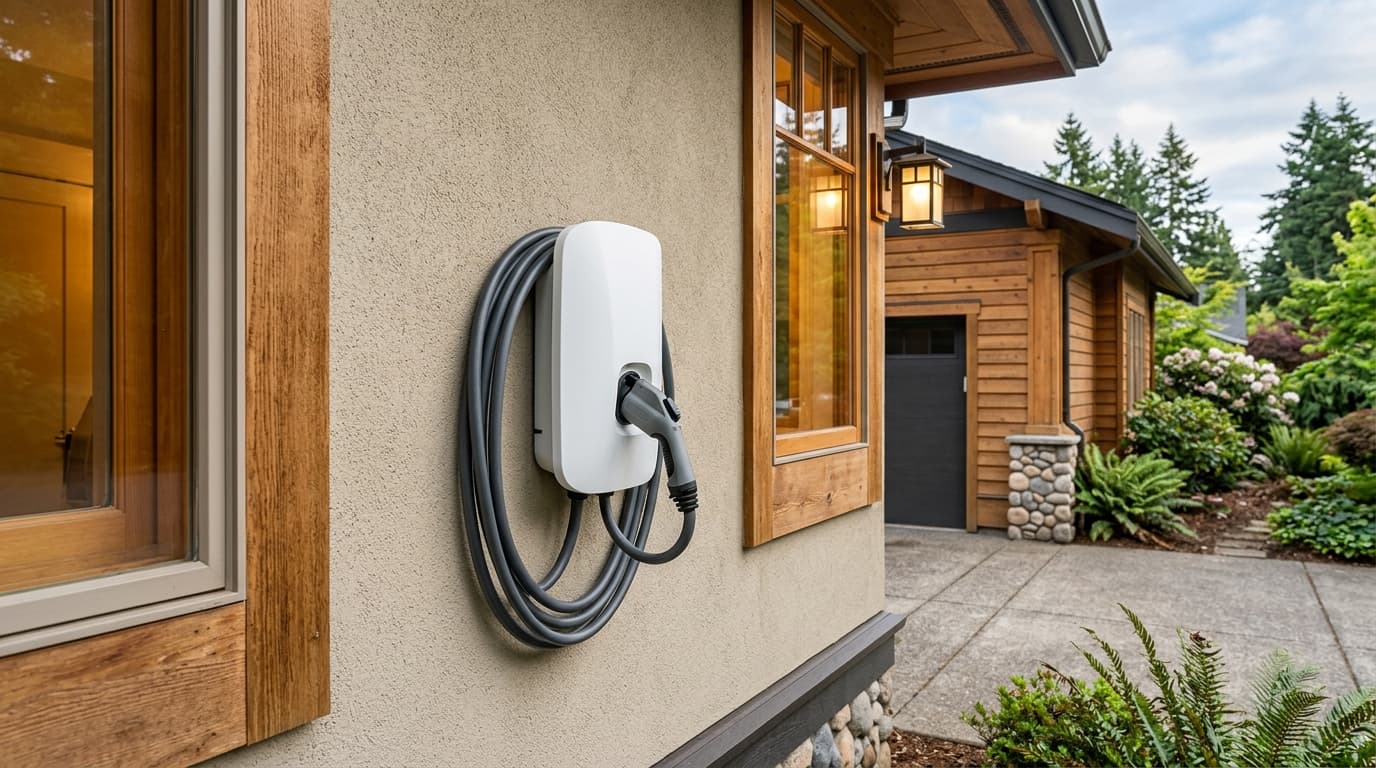
EV charger installation cost in Vancouver, WA runs $850 to $2,800 in 2026 for a typical Level 2 hardwired job, and $4,000 to $7,500 if your home also needs an electrical panel upgrade to handle the new load. If you're already remodeling a kitchen, finishing a garage, or adding an ADU, bundling the charger circuit with your active project saves 20–30% on labor because the electrician is already on-site and the walls are open.
This guide breaks down 2026 pricing by scenario, walks through when a 100-amp panel needs an upgrade, explains NEC 2023 EV-ready code as it applies to Clark County remodels, and covers the Washington L&I permit process, Clark Public Utilities load rules, and federal and local rebates. Washington now has more than 165,000 registered EVs per the Washington State Department of Licensing, and Clark County alone passed 10,000 registered EVs in 2025 — panel capacity and charger planning are no longer optional considerations during a remodel.
TL;DR
A Level 2 EV charger installed in Vancouver, WA costs $850–$2,800 if your panel has capacity, or $4,000–$7,500 if a 100-to-200-amp panel upgrade is needed. The 240V 40-amp circuit and wallbox cost $500–$1,500. Washington L&I permit fees run $56–$112. NEC 2023 now requires EV-ready infrastructure in many new builds. The federal 30C tax credit covers 30% up to $1,000. Bundling with a remodel saves 20–30% on labor.
Get an EV Charger Installation Estimate
Planning a remodel in Vancouver, WA? Our team coordinates Level 2 charger wiring, panel upgrades, and conduit runs with your renovation scope so everything happens while walls are open. Free consultations with detailed pricing.
Request a Free EstimateEV Charger Installation Cost Breakdown (2026)
EV charger installation cost in Vancouver, WA depends on four variables: the wallbox unit you pick, the length and routing of the 240V circuit, whether the panel has spare capacity, and whether the installation is interior or exterior. Portland–Vancouver metro electricians charge 8–12% above national averages per Bureau of Labor Statistics wage data, and Vancouver's 8.7% sales tax (6.5% state + 2.2% local) applies to materials.
These are the most common installation scenarios and what Vancouver, WA homeowners pay in 2026:
- Best-case (panel adjacent to garage): $850–$1,400 — short conduit run, 200A panel has spare slots, hardwired Level 2 charger
- Typical garage install: $1,400–$2,800 — 20–40 ft of conduit, drilling through walls, mounting bracket, permit, and inspection
- Exterior or detached garage: $2,400–$4,200 — trenching, weatherproof conduit, NEMA 4X enclosure, longer wire run
- Install + 100-to-200A panel upgrade: $4,000–$7,500 — full electrical service upgrade plus the new 40-amp EV circuit
- Install + new subpanel for ADU/garage: $3,200–$6,000 — common for garage conversion projects that add living space and EV charging together
Level 2 EV Charger Installation Cost by Scenario — Vancouver, WA (2026)
What's included in the cost
When you get a quote for EV charger installation in Vancouver, WA, the line items typically include:
- Wallbox / charger unit: $400–$900 for hardwired Level 2 models from Wallbox, ChargePoint, Tesla, Emporia, or Grizzl-E
- 40-amp double-pole breaker: $35–$80
- 6 AWG copper wire and conduit: $4–$8 per linear foot installed
- Mounting hardware and disconnect: $60–$180
- Licensed electrician labor: $110–$160 per hour, 4–8 hours typical
- Washington L&I electrical permit: $56–$112
- State and local inspection coordination: included in labor by most contractors
A simple way to gut-check a quote: the wallbox plus permit should run roughly $500–$1,100, and everything above that line is labor and conduit. A bid significantly outside that pattern usually means either a long conduit run, panel work, or a contractor padding margin.
Level 1 vs Level 2 vs Level 3: Which Fits a Vancouver Home?
For 99% of Vancouver, WA homeowners the right answer is a Level 2 charger. Here's why the levels matter and when each makes sense.
Level 1 (120V standard outlet)
A Level 1 charger plugs into any standard 120V household outlet and adds 3–5 miles of range per hour. For a typical EV with a 75 kWh battery, a full charge takes 40+ hours. Level 1 works for plug-in hybrids and for low-mileage drivers (under 30 miles per day), but it's painfully slow for full battery EVs and shouldn't be your primary charging plan in a household that drives more than 25 miles daily.
Level 2 (240V dedicated circuit)
A Level 2 charger runs on a 240V 40-amp dedicated circuit (sometimes 48-amp on 60-amp circuits) and adds 25–40 miles of range per hour. A full overnight charge from 20% to 80% takes 4–7 hours. This is the standard residential install and what every EV manufacturer recommends for daily charging. Cost is $850–$2,800 installed for most homes.
Level 3 (DC fast charging)
Level 3 chargers deliver 480V DC power and can charge an EV to 80% in 20–40 minutes. They cost $20,000–$80,000 installed, require commercial three-phase power, and are not realistic for residential properties in Clark County. These are the chargers you find at Electrify America, ChargePoint, and Tesla Supercharger stations along I-5 and SR 14.
Bottom line for Vancouver, WA homes: install Level 2. Skip Level 1 unless you're a low-mileage hybrid driver, and ignore Level 3 entirely for residential use.
EV Charger Electrical Panel: Do You Need an Upgrade?
The biggest variable in EV charger installation cost is whether your existing electrical panel can handle the new load. A Level 2 charger typically draws 32–48 amps continuously, which the National Electrical Code requires to be sized at 125% — meaning a 40-amp charger needs a 50-amp circuit calculation. That extra capacity has to come from somewhere.
Before installing a charger, a licensed electrician will perform an NEC Article 220 load calculation that totals your existing connected loads (range, dryer, water heater, HVAC, lighting, receptacles) and compares it against your service amperage. If the calculation shows you have less than 50 amps of headroom, you have three options.
Option 1: Panel upgrade
A 100-to-200-amp service upgrade in Vancouver, WA runs $1,800–$4,500 per our electrical panel upgrade cost guide. If your home is on 100-amp service and you also plan to add a heat pump, induction range, or ADU, the upgrade is likely a good investment regardless of the EV charger.
Option 2: Load management device
Smart load management devices like the DCC-9, Wallbox Power Boost, or NeoCharge let you add an EV charger without a panel upgrade by automatically reducing charger current when other large loads are active. These devices cost $400–$900 installed and are an excellent workaround for homes with 100-amp panels that can't justify a full upgrade. They are NEC-approved under Article 750 and pass Washington L&I inspection.
Option 3: Lower-amperage charger circuit
Most Level 2 chargers can be set to 24-amp or 32-amp output instead of 40 or 48. A 24-amp charger only requires a 30-amp circuit and adds 18–22 miles of range per hour, which is still plenty for a typical commuter. This is the cheapest workaround for homes with limited panel capacity, and it preserves the option to step up later if you upgrade the panel.
Pro tip: if you're in the planning stage of a kitchen remodel, ADU build, or whole-home renovation, request a load calculation from your electrician before drywall goes up. Knowing your real headroom number lets you decide whether to upgrade the panel now (cheap during a remodel) or live with a load management device.
Why a Remodel Is the Best Time to Install a Level 2 Charger
Adding a Level 2 charger circuit to an existing home as a standalone job means an electrician shows up, drills new holes, fishes wire through finished walls, patches drywall, and bills you for every minute. The same circuit run during a remodel takes a fraction of the time because the walls are already open, the rough electrical phase is happening anyway, and the contractor is already on-site.
Here's how the savings stack up across common remodel scenarios in Vancouver, WA:
- Kitchen remodel: Adding a 240V circuit from the panel to a garage during a kitchen remodel saves $400–$700 in labor because the rough electrical crew is already pulling wire and the wall between the kitchen and garage is often opened up for new appliance circuits anyway.
- Garage conversion or finish: If you're finishing your garage or doing a garage conversion to ADU, the EV charger circuit gets bundled with the new subpanel work for $300–$500 of incremental cost rather than $1,500+ standalone.
- Whole-home or addition: During a whole-home remodel, the panel upgrade (if needed), EV circuit, and any smart home or solar pre-wiring all fold into a single rough electrical phase, often saving 25–35% on the combined electrical scope.
- ADU construction: An ADU build in Vancouver, WA almost always involves a new subpanel, which makes adding an EV charger essentially a $200–$400 add-on rather than a separate project.
- Siding or window replacement: If your EV charger needs an exterior wire run, doing it while siding is off the wall is dramatically cheaper than cutting back into finished fiber cement siding later.
Standalone vs. Bundled-with-Remodel Cost — Vancouver, WA (2026)
NEC 2023 EV-Ready Code and Clark County Requirements
Washington state adopted the 2023 National Electrical Code in 2024, and it brings real implications for new construction and substantial remodels in Clark County. The key change for homeowners is NEC Article 625, which now treats EV charging infrastructure as a primary load that must be planned for during electrical design rather than added later.
Specific requirements that affect Vancouver, WA remodel and new-construction projects:
- EV-ready capacity: New single-family homes and ADUs must include at least one EV-ready parking space with a dedicated 40-amp 240V circuit and receptacle, or pre-installed conduit and breaker space sized for one.
- Continuous load sizing: EV chargers must be sized at 125% of nameplate current, so a 40-amp charger requires a 50-amp circuit calculation. This rule existed before but is now strictly enforced.
- GFCI protection: All 240V receptacles used for EV charging require GFCI protection per NEC 210.8(F), adding $50–$120 to the breaker cost.
- Panel labeling: All EV charger circuits must be clearly labeled in the panel directory and at the disconnect.
- Energy management systems: NEC 2023 formally allows energy management systems (load management devices) to size circuits below the full nameplate load when properly installed, which is what legitimizes products like the DCC-9 and Wallbox Power Boost.
The practical takeaway: if you're building a new ADU, doing an addition, or pulling a permit for major electrical work, your contractor needs to plan for EV capacity even if you don't own an EV today. Skipping this step now means a more expensive retrofit later.
Permits, Inspections, and Clark PUD Load Rules
Every Level 2 EV charger installation in Vancouver, WA requires an electrical permit through Washington Department of Labor & Industries (L&I). Unlike kitchen and bath remodels that route through Clark County or City of Vancouver building departments, electrical permits in Washington are issued and inspected exclusively by L&I.
Permit fees and timeline
Current 2026 L&I fees for residential EV charger work:
- One 240V branch circuit (no service change): $56
- Branch circuit + minor panel work: $86–$112
- Service change / panel upgrade: $135–$210 depending on amperage
- Inspection scheduling fee (after-hours): $148+ if you need an inspection outside normal business hours
Permit issuance is typically same-day to 3 business days for residential electrical work. The inspection is scheduled within 2–5 business days of work completion, and L&I inspectors are well-acquainted with EV charger installations — a properly executed job passes on the first inspection in our experience.
Clark Public Utilities load notification
For panel upgrades and large EV loads, Clark Public Utilities asks contractors to notify them so they can verify the transformer serving your home has capacity. For a typical 40-amp charger on an existing 200-amp service, no notification is needed. For a 100-to-200-amp service upgrade or for adding multiple chargers, your electrician will coordinate with Clark PUD as part of the permit process.
Pro tip: if you live on a long rural feeder in east Clark County or up around Hockinson and Battle Ground, ask your electrician to confirm transformer capacity early. Some older neighborhoods have transformers that get marginal when several homes add EVs and heat pumps in the same year, and Clark PUD will sometimes need to upsize the transformer before a panel upgrade can be energized.
Choosing a Charger for the Pacific Northwest Climate
Vancouver, WA gets roughly 42 inches of rain per year per the National Weather Service, with most of it falling October through May. That matters for EV charger selection because moisture, temperature swings, and condensation can shorten the life of a charger that isn't built for outdoor use. The same logic that drives our advice on PNW-friendly remodeling materials applies to EV equipment.
Look for these specs when picking a Level 2 charger for a Vancouver, WA installation:
- NEMA 4 or NEMA 4X enclosure rating: required for any exterior install, recommended even for attached garages that aren't fully sealed
- Operating temperature range: at least -22°F to 122°F covers Vancouver's rare cold snaps and hot summer afternoons
- Hardwired (not plug-in) connection: NEC 2023 requires GFCI protection for plug-in chargers, but hardwired models don't and are more reliable in humid environments
- Wi-Fi or app integration: useful for scheduling charging during off-peak hours when Clark PUD rates are lowest
- UL listing and Washington-approved equipment: confirm with your electrician before purchase — L&I will fail an inspection if the equipment isn't on the approved list
Popular models for Vancouver, WA homes
Models we see most often on Clark County installations:
- Wallbox Pulsar Plus (40A or 48A): $649–$799, NEMA 4, hardwired or plug-in, Wi-Fi
- ChargePoint Home Flex (50A): $549–$699, NEMA 3R, app integration, Energy Star certified
- Tesla Wall Connector (48A): $475, NEMA 3R, hardwired only, ideal if you drive a Tesla
- Emporia EV Charger (48A): $399, NEMA 4, plug-in, energy-monitoring app
- Grizzl-E Classic (40A): $399, NEMA 4, rugged metal housing, no Wi-Fi (good for homeowners who want reliability over apps)
Where Your EV Charger Install Dollar Goes — Typical $2,000 Vancouver Job
Rebates, Tax Credits, and Incentives
Vancouver, WA homeowners can stack federal, state, and utility incentives to cut the net cost of an EV charger installation by 30–45%. For a complete view of available programs, see our 2026 energy-efficiency rebates guide for Vancouver, WA.
- 30C Alternative Fuel Infrastructure Tax Credit: Federal credit for 30% of EV charger installation costs (equipment and labor) up to $1,000 per residential unit. Available through 2032 under the Inflation Reduction Act. Claimed on IRS Form 8911. Note: the credit is only available in census tracts that meet specific income or rural criteria; Clark County contains multiple eligible tracts — check the IRS-published map.
- 25C Energy Efficient Home Improvement Credit: If your installation includes a panel upgrade that enables electrification (heat pump, induction range, EV charger), the panel upgrade may qualify for up to $600 per IRS guidance. This stacks with the 30C credit.
- Clark Public Utilities EV programs: Clark PUD offers time-of-use rate plans for EV owners and has periodically run charger rebate pilots. Programs change year to year — check ClarkPublicUtilities.com for current offerings before installing.
- Washington state sales tax exemption (vehicles): While the charger itself is taxable, certain EVs purchased in Washington qualify for partial sales tax exemption under RCW 82.08.809, which improves the overall economics of going electric.
- Employer charging programs: Some Clark County and Portland metro employers reimburse home EV charging costs for employees who drive company-allowed EVs. Worth checking with your HR department.
Worked example: a $2,000 Level 2 install in a qualifying Clark County census tract, paired with a $3,500 panel upgrade that enables a future heat pump, could net out around $1,200 federal credit between 30C and 25C, leaving a combined out-of-pocket of roughly $4,300 for both jobs — significantly less than doing them separately a year apart.
Ready to Plan Your EV Charger Install?
Our team helps Vancouver, WA homeowners coordinate Level 2 charger circuits, panel upgrades, and conduit runs with their renovation timeline. We handle Washington L&I permitting, Clark PUD coordination, and inspection scheduling so you don't have to.
Get a Free EstimatePlanning Checklist for Your Remodel
If you're heading into a remodel and want to add EV charging now or leave the door open for it later, work through this checklist with your contractor before rough electrical:
- Get a load calculation. Have your electrician run an NEC Article 220 calculation on your existing service so you know your real headroom.
- Pick your charger location. Inside the garage adjacent to the panel is the cheapest install. Exterior installs and detached garages add cost but are sometimes necessary.
- Decide on amperage. 40-amp (32A output) is the standard. 48-amp gives faster charging at a higher install cost. Confirm your EV can actually use the higher rate.
- Choose a charger model. Pick a NEMA-rated hardwired Level 2 charger from the popular-models list above and confirm it's on Washington L&I's approved equipment list.
- Bundle with the rough electrical phase. Make sure your remodel scope includes the EV circuit so the conduit runs while walls are open.
- Pre-wire even if you're not buying a charger yet. Running conduit and a 50-amp breaker now costs $300–$600. Doing the same job after the remodel finishes costs $1,500–$2,500.
- Plan for incentives. Confirm your census tract eligibility for the 30C credit, check Clark PUD's current EV programs, and save all receipts and the L&I permit for your tax filing.
- Document the install. Photograph the open walls during rough-in, label the breaker clearly, and keep a copy of the inspection report. This matters for resale value and warranty claims.
One real-world scenario from our project files: a Cascade Park homeowner remodeling a 1992 ranch wanted to add an EV charger but was on a 100-amp panel. We ran the load calculation and found the home was already maxed out by an electric water heater and an electric range. The remodel scope was already replacing the kitchen, so we bundled a 100-to-200-amp panel upgrade ($2,400), a 240V EV circuit to the garage ($600 incremental), and pre-wiring for a future heat pump ($300 incremental) into the rough electrical phase. Total electrical cost: $3,300. Doing those three jobs separately a year later would have run $5,800–$6,500 — a $2,500+ savings just from scheduling them together.
Sources
- EnergySage — How Much Does EV Charger Installation Cost?
- Washington L&I — Electrical Permits, Fees & Inspections
- EC&M — Five Ways the 2023 NEC Is Impacting the Electrified Home
- Washington State DOL — Electric Vehicle Population Data
- IRS — Alternative Fuel Vehicle Refueling Property Credit (30C)
- Bureau of Labor Statistics — Electrician Wage Data
- Clark Public Utilities — Residential Programs
Frequently Asked Questions
How much does it cost to install a Level 2 EV charger in Vancouver, WA?
A Level 2 EV charger installation in Vancouver, WA costs $850 to $2,800 in 2026 for a typical residential job. The price covers the 240-volt 40-amp circuit, the wallbox unit ($400–$900), labor for a licensed electrician, the Washington L&I electrical permit, and final inspection. Installations in attached garages on the same wall as the panel sit at the low end. Long conduit runs, exterior mounting, panel work, or a full panel upgrade can push the total to $4,000–$7,500. Bundling the charger circuit with an active remodel typically saves 20–30% on labor because the electrician is already on-site.
Do I need a panel upgrade to install a Level 2 EV charger?
Not always. A Level 2 charger draws 32 to 48 amps continuously, so your panel must have both available breaker space and enough spare capacity in a load calculation. Many Vancouver, WA homes built after 2000 already have 200-amp panels and can accept a 40-amp EV circuit without an upgrade. Homes built before the mid-1990s often have 100-amp panels and frequently need a 200-amp service upgrade, especially if they also run electric ranges, electric water heaters, or heat pumps. A licensed electrician will run a NEC Article 220 load calculation to confirm whether your existing service can handle the new charger.
Does an EV charger installation require a permit in Clark County?
Yes. All 240-volt circuit work in Washington requires an electrical permit through the Department of Labor and Industries (L&I). For a Level 2 EV charger circuit in Vancouver, WA the permit fee runs $56 to $112 depending on whether the work includes a service change. Your licensed electrician pulls the permit and schedules the L&I inspection. DIY EV charger installations are not permitted under Washington law unless you are working on your own owner-occupied single-family home and pull the homeowner permit yourself.
How long does an EV charger installation take during a remodel?
A standalone Level 2 charger installation takes 4 to 8 hours of on-site work. When bundled with a remodel, the rough wiring is run during the open-wall electrical phase and the wallbox is mounted and energized during finish electrical, adding no extra days to the overall project. Permit issuance through Washington L&I is same-day to 3 business days for residential electrical work, and the inspection is scheduled within 2 to 5 business days of completion.
What is the best Level 2 EV charger for a Pacific Northwest home?
For Vancouver, WA homes the best Level 2 chargers are NEMA 4 or NEMA 4X rated for outdoor wet-location use, since most installations are in attached garages or exterior walls exposed to PNW rain and humidity. Popular models that meet these standards include the Wallbox Pulsar Plus, ChargePoint Home Flex, Tesla Wall Connector, Emporia EV Charger, and Grizzl-E Classic. Look for hardwired (not plug-in) models on a 48-amp circuit if you want maximum future-proofing, and confirm the charger is on the Washington-approved equipment list before purchase.
Are there rebates for installing an EV charger in Vancouver, WA?
Yes. The federal 30C Alternative Fuel Infrastructure Tax Credit covers 30% of EV charger installation costs (equipment and labor) up to $1,000 per residential unit, available through 2032 under the Inflation Reduction Act. Clark Public Utilities periodically offers EV charger rebates and time-of-use rate programs for residential customers — current programs and amounts change year to year, so check ClarkPublicUtilities.com for the latest. Stacking the federal credit with a utility rebate can cut your net cost by 35–45%.
GVX Remodeling Team
Vancouver, WA general contractor with 15+ years of residential remodeling experience across Clark County. Licensed, bonded, and insured in Washington state. Our team has completed 200+ renovation projects ranging from kitchen remodels to whole-home renovations and ADU construction, with electrical scope coordinated through licensed Washington electricians on every job.