
Deck vs. Patio: Which Costs Less in Vancouver, WA? (2026 Comparison)
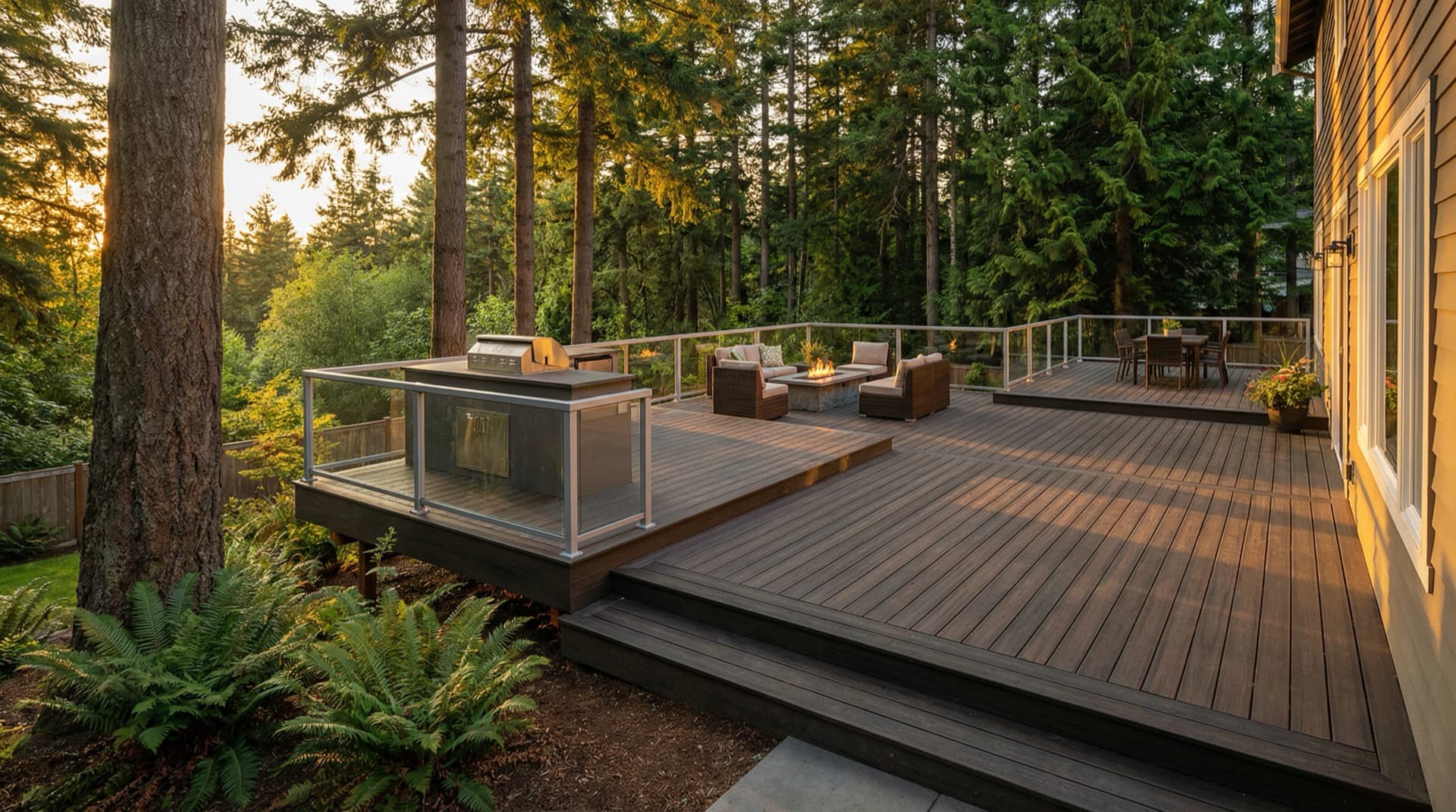
Every Vancouver homeowner planning an outdoor space hits the same fork in the road: build a deck or pour a patio? The cost gap is wider than most people expect, and the “right” answer depends on your lot, your budget, how you use the space, and whether you are willing to maintain it through 164 days of annual precipitation.
This guide compares real 2026 pricing for both options in Clark County — upfront cost, 10-year total cost of ownership, ROI at resale, and how each holds up against 42 inches of rain per year. No filler, no guessing. Just the numbers you need to decide.
Quick Answer
Patios cost $5–$17/sqft. Decks cost $25–$55/sqft. A 300-sqft concrete patio runs $1,500–$4,500 installed. The same footprint in composite decking costs $10,500–$16,500. But decks return up to 111% at resale in the Pacific region, while patios recoup 50–80%. Your best choice depends on slope, budget, and how long you plan to stay.
Side-by-Side Cost Comparison: Deck vs. Patio (2026)
The table below shows what Vancouver-area homeowners pay in 2026 for the most common deck and patio options, installed. All figures include materials, labor, and basic site prep.
| Option | Cost/Sq Ft | 300 Sq Ft Total | Lifespan |
|---|---|---|---|
| Concrete patio (poured) | $5 – $15 | $1,500 – $4,500 | 25 – 50 years |
| Paver patio | $10 – $17 | $3,000 – $5,100 | 25 – 50 years |
| Wood deck (pressure-treated) | $25 – $50 | $7,500 – $15,000 | 10 – 15 years |
| Composite deck | $35 – $55 | $10,500 – $16,500 | 25 – 50 years |
At the low end, a basic concrete patio costs roughly one-fifth of a composite deck for the same square footage. That raw price gap makes patios the obvious budget pick — but upfront cost is only part of the equation.
Deck Costs in Vancouver, WA (2026 Breakdown)
Deck pricing in Clark County depends on material, height above grade, and features. Here is what each tier typically includes.
Pressure-Treated Wood: $25–$50/sq ft
The lowest-cost deck option. Includes framing, footings, ledger board, and basic railing. Pressure-treated pine is readily available and familiar to every contractor in the area. The tradeoff: it absorbs moisture, requires staining every 1–2 years, and lasts only 10–15 years in our climate without aggressive upkeep.
Composite (Trex, TimberTech): $35–$55/sq ft
The most popular mid-to-high option for PNW homeowners. Composite won't rot, warp, or grow mold. It never needs staining. Manufacturer warranties run 25–50 years. Upfront cost is 40–70% higher than wood, but maintenance savings close the gap within 5–7 years. For a deeper breakdown, read our full deck cost guide for Vancouver, WA.
Common Add-Ons
| Feature | Typical Cost |
|---|---|
| Railing upgrade (cable/glass) | $50 – $120/linear ft |
| Stairs (per flight) | $500 – $2,500 |
| Built-in lighting | $500 – $3,000 |
| Pergola or shade structure | $3,000 – $10,000 |
| Old deck removal | $5 – $15/sq ft |
Patio Costs in Vancouver, WA (2026 Breakdown)
Patios sit at or near grade level, which eliminates the need for structural framing, footings, and railings. That simplicity keeps prices low.
Poured Concrete: $5–$15/sq ft
The most budget-friendly hard surface. A basic broom-finished slab runs $5–$8 per square foot. Stamped concrete with color and texture pushes the price to $10–$15. Concrete lasts 25–50 years, handles moisture well, and requires almost no annual maintenance. The main risk in Clark County is cracking from tree root pressure or poorly compacted subgrade on our clay-heavy soil.
Concrete Pavers: $10–$17/sq ft
Pavers offer more design flexibility than poured concrete. Individual units can be replaced if they crack, and the interlocking pattern handles ground movement better than a solid slab. Budget $10–$14 for standard pavers and $14–$17 for premium natural stone. Joint sand needs replenishment every 2–3 years, and weeds can colonize gaps without polymeric sand.
Common Patio Add-Ons
| Feature | Typical Cost |
|---|---|
| Stamped/colored concrete upgrade | +$5 – $10/sq ft |
| Retaining wall (for grading) | $3,000 – $10,000+ |
| Fire pit (built-in) | $3,000 – $6,000 |
| Covered patio roof | $12,500 – $25,000 |
Adding a cover transforms a patio from a fair-weather surface into year-round living space. For full details on that upgrade path, see our covered patio cost guide for Vancouver, WA.
10-Year Total Cost of Ownership
Upfront price only tells part of the story. Maintenance, repairs, and replacement frequency change the math — especially in a wet climate. The chart below models 10-year total cost for a 300-square-foot outdoor surface, including installation, annual maintenance, and one mid-life repair.
10-Year Total Cost of Ownership — 300 Sq Ft (Vancouver, WA)
Concrete patios dominate on total cost. A poured slab with annual sealing costs roughly $4,200 over ten years. A pressure-treated wood deck costs $22,500 once you factor in biannual staining ($800–$1,200 each time), board replacements, and potential structural repairs from moisture damage. Composite decks land at roughly $14,500 — higher upfront, but almost no recurring cost beyond an occasional soap-and-water wash.
Key takeaway: If you pick wood, budget for maintenance from day one. If you skip staining for even two years in Vancouver's climate, you are buying a replacement deck in year 12 instead of year 15.
ROI and Resale Value: Deck vs. Patio
Resale value is where decks close the cost gap. The 2025 Cost vs. Value Report (Zonda/Remodeling Magazine) shows wood deck additions in the Pacific region returning 111.2% of project cost at resale. Composite decks return 88.3%. Patios typically recoup 50–80% depending on finish quality and whether the space is covered.
ROI at Resale — Pacific Region (2025 Cost vs. Value)
A wood deck addition that costs $16,000 adds roughly $17,800 to your home's sale price in the Pacific region — one of the few projects that actually makes money at resale. Composite decks don't quite break even, but the 88.3% return is still strong. Patios cost far less to build, so even a 65% return on a $4,000 patio ($2,600) is a reasonable outcome.
For a full breakdown of which remodeling projects deliver the best returns in Clark County, see our best ROI home renovation guide.
PNW Climate: How 42 Inches of Rain Affects Your Decision
Vancouver, WA receives 42.01 inches of precipitation annually across 164 days with measurable rainfall (US Climate Data). That is more rain days than Seattle and nearly four times the precipitation of Phoenix. Every material choice needs to answer one question: how does it handle constant moisture?
Decks and Moisture
Wood decks absorb water. Without regular sealing, pressure-treated lumber warps, splinters, and grows mold within 2–3 years in our climate. Moss colonizes shaded boards by the second winter. Annual power washing and biannual staining are not optional here — they are survival maintenance.
Composite decks are non-porous. Water beads off the surface. Moss can still grow in shaded areas, but it washes off with soap and water instead of requiring chemical treatment. This is the primary reason composite outsells wood in the Portland/Vancouver metro.
Patios and Drainage
Concrete patios handle rain well if graded properly (minimum 1/4-inch slope per foot away from the house). The main PNW risk is surface staining from moss and algae, which is cosmetic and treatable with annual cleaning. Freeze-thaw cracking is rare in Vancouver since winter temperatures rarely stay below freezing for extended periods.
Paver patios allow water to drain through joints, which reduces pudding. But Clark County's clay subsoil drains poorly, so pavers here need a thicker gravel base (6–8 inches minimum) than you would see recommended in sandy-soil regions. Without it, pavers heave and settle unevenly within a few years.
Drainage Comparison
| Factor | Deck | Patio |
|---|---|---|
| Water drainage | Drains between boards | Requires proper grading |
| Moss/algae risk | High (wood); Low (composite) | Moderate (cosmetic only) |
| Clay soil impact | Minimal (elevated) | Significant (needs thick base) |
| Slip risk when wet | Moderate (wood); Low (textured composite) | Low (broom-finished concrete) |
Permits for Decks and Patios in Vancouver, WA
Permit requirements differ significantly between decks and patios, which affects both timeline and cost.
Deck Permits
In Vancouver, WA, any deck more than 18 inches above grade requires a building permit. Most practical decks exceed this threshold. Permits also apply to any deck attached to the house via a ledger board. Expect permit fees of $200–$800 and a 2–4-week processing timeline through the City of Vancouver Building Division.
Patio Permits
Most at-grade patios — concrete slabs, pavers, and gravel — do not require a building permit in Vancouver. Exceptions include patios with covered structures, electrical work, plumbing (outdoor kitchens), or retaining walls over 4 feet. If your patio is simply a flat surface at ground level, you can typically start immediately with no permit wait.
For a complete walkthrough of the permit process, read our Vancouver, WA remodeling permits and inspections guide.
Permit Quick Reference
Deck
- Permit required if >18″ above grade
- Permit fees: $200–$800
- Processing: 2–4 weeks
Patio
- No permit for at-grade surfaces
- Permit needed for covers, electrical, plumbing
- Can start immediately (basic patio)
Decision Matrix: Which Should You Build?
Use this framework to match your situation to the best option. There is no universal winner — it depends on your specific lot, budget, and goals.
| Your Situation | Best Choice | Why |
|---|---|---|
| Tight budget (<$5K) | Concrete patio | Only option in this range; long lifespan, low maintenance |
| Sloped or elevated lot | Deck | Spans elevation changes without excavation or retaining walls |
| Selling within 3 years | Wood deck | 111% ROI in the Pacific region; strongest resale return |
| Staying 10+ years, want low maintenance | Composite deck or concrete patio | Both last 25–50 years with minimal upkeep |
| Flat lot, maximum entertaining space | Paver patio | Largest area for the budget; design flexibility with patterns |
| Want a covered outdoor room | Deck or patio + cover | Either works as a base; cover is the key investment for PNW rain |
| No maintenance tolerance | Poured concrete | Lowest maintenance of all options; seal once every 3–5 years |
The most common path we see in Clark County is a composite deck for homes with elevation changes or second-story access, and a concrete or paver patio for flat lots where budget matters. Many homeowners end up building both — a small deck off the main living area and a larger patio below for entertaining.
Not Sure Which Is Right for Your Yard?
We will evaluate your lot, walk through both options with realistic pricing, and help you pick the best fit for your budget and goals. No pressure, no obligation.
Schedule a Free ConsultationDeck vs. Patio FAQ
Is a deck or patio cheaper to build in Vancouver, WA?
A patio is significantly cheaper upfront. Concrete patios cost $5–$15 per square foot installed, while wood decks start at $25/sqft and composite decks at $35/sqft. A 300-square-foot concrete patio runs $1,500–$4,500, compared to $7,500–$16,500 for a comparable deck.
Which lasts longer in the Pacific Northwest, a deck or a patio?
Concrete patios last 25–50 years with minimal maintenance. Composite decks match that lifespan but cost more upfront. Pressure-treated wood decks last 10–15 years without aggressive staining and sealing. Pavers last 25–50 years but may shift or settle on Clark County's clay soil.
Do I need a permit for a deck or patio in Vancouver, WA?
Decks over 18 inches above grade require a building permit in Vancouver, WA. Most at-grade patios do not require a permit unless they involve electrical, plumbing, or a covered structure. Always verify with the City of Vancouver Building Division for your specific project.
Which adds more resale value, a deck or a patio?
Wood deck additions return roughly 111% of cost in the Pacific region (2025 Cost vs. Value). Composite decks return about 88%. Patios typically recoup 50–80%. Decks deliver higher ROI percentages, but patios cost less to build, so your actual net investment depends on project scope and how long you plan to stay.
Can I build a patio on sloped ground?
Yes, but slope adds cost. Minor grades require grading ($500–$2,000), while steep slopes may need retaining walls ($3,000–$10,000+). On significantly sloped lots in Clark County's hilly terrain, a raised deck is often cheaper than excavating and building retaining walls for a level patio.
Sources & References
- HomeGuide — Concrete Patio Cost Guide (2025)
- Bob Vila — Paver Patio Cost Guide (2025)
- Fixr — Deck Building Cost Estimator (2025)
- Zonda/Remodeling Magazine — 2025 Cost vs. Value Report (Pacific region)
- US Climate Data — Vancouver, WA (precipitation and rain days)
- City of Vancouver, WA — Building Permits and Applications
- ICFA — Concrete Patio Lifespan and Maintenance Data (2025)
Written by
GVX Remodeling Team
Deck, patio, and outdoor living cost guidance from the GVX Remodeling team, helping Clark County homeowners choose the right outdoor surface for their lot and budget.