
Cabinet Refacing vs. Replacement: Cost and ROI Guide for Vancouver, WA (2026)
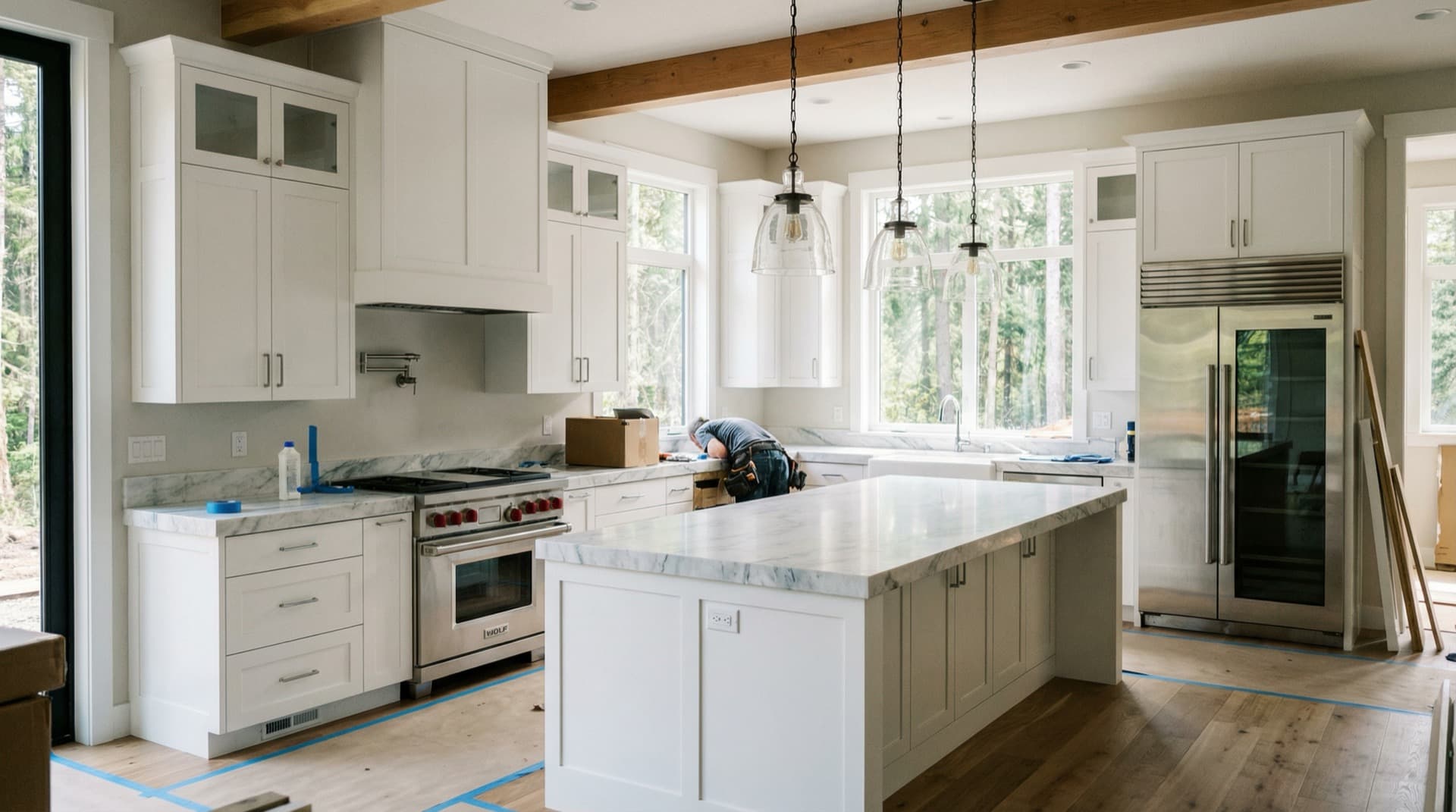
Cabinets eat up 29% of a typical kitchen remodel budget, according to the National Kitchen & Bath Association (NKBA). That makes the refacing-vs.-replacement decision the single biggest cost lever Vancouver, WA homeowners can pull. Refacing runs $3,000–$13,500 nationally. Full replacement starts around $15,000 and climbs past $35,000. The right choice depends on your cabinet condition, layout goals, budget, and how long you plan to stay in the home.
This guide breaks down 2026 pricing for both options, compares ROI backed by Cost vs. Value data, and covers a practical hybrid approach that many Clark County homeowners overlook. We've also flagged how 2026 import tariffs are shifting the math on imported cabinet lines.
TL;DR
Cabinet refacing costs roughly half of full replacement ($8,250 vs. $15,000–$35,000) and finishes in days, not weeks. Minor kitchen remodels that include refacing recoup 113% of cost at resale nationally — and 124.5% in Washington state, per the 2025 Cost vs. Value Report. Choose refacing when your boxes are solid and the layout works. Choose replacement when cabinets are damaged or you need a new layout.
Get a Cabinet Estimate
Not sure whether refacing or replacement is right for your kitchen? Our team evaluates your cabinet condition and provides a free, no-pressure estimate.
Request a Free EstimateWhat Is Cabinet Refacing vs. Cabinet Replacement?
The average U.S. cabinet refacing project costs $8,250 compared to $15,000–$35,000 for full replacement, per Fixr.com and Kitchen Cabinet Guys. The price gap starts with what each process actually involves — one preserves your existing cabinet structure while the other tears everything out and starts fresh.
Cabinet refacing: what's included
Refacing keeps the existing cabinet boxes mounted to your walls. A contractor applies new veneer — laminate, wood, or rigid thermofoil — over the box surfaces, then installs new doors, drawer fronts, and hardware. Hinges and drawer slides are typically upgraded to soft-close. The result looks like a completely new kitchen without demolition or structural work.
Refacing works best when the existing boxes are plumb, square, and structurally sound. If your cabinet frames haven't warped, delaminated, or suffered water damage, they can support new faces for another 15–20 years.
Cabinet replacement: what's included
Replacement means removing every cabinet from the kitchen — uppers, lowers, and any specialty pieces — then installing a brand-new set. This includes demolition, wall repair or patching, and potentially rerouting plumbing or electrical if the layout changes.
Replacement gives you full control over layout, cabinet depth, interior accessories, and material quality. It's the only option if you want to add or relocate cabinets, switch from a galley to an L-shape, or add an island with base cabinets.
How Much Does Cabinet Refacing Cost in 2026?
Cabinet refacing averages $8,250 nationally, with a typical range of $3,000–$13,500, according to Fixr.com (2025). Labor accounts for 50–70% of the total project cost, making it the dominant expense. Material choice is the second biggest variable — laminate costs a fraction of solid hardwood.
Cost per linear foot by material
| Material | Cost per linear foot | Best for |
|---|---|---|
| Laminate | $80 – $125 | Tight budgets, moisture-prone areas |
| Rigid thermofoil (RTF) | $90 – $150 | Consistent color, easy cleaning |
| Wood veneer | $100 – $250 | Natural look, mid-range budgets |
| Solid hardwood | $200 – $500 | Custom appearance, long-term durability |
Source: Fixr.com (2025 data). Includes doors, drawer fronts, veneer, and hardware.
For a typical Vancouver, WA kitchen with 25 linear feet of cabinetry, laminate refacing runs $2,000–$3,125 in materials alone. Solid hardwood on that same kitchen pushes material costs to $5,000–$12,500. Add 50–70% for labor and you get the full project range.
What drives refacing costs higher
- Kitchen size: More linear feet means more doors, more veneer, and more labor hours.
- Door style complexity: Shaker-style doors cost less than raised-panel or mullion glass doors.
- Interior upgrades: Pull-out shelves, lazy Susans, and soft-close hardware add $500–$2,000.
- Crown molding and trim: Decorative trim adds $300–$800 per kitchen.
How Much Does Cabinet Replacement Cost in 2026?
Full cabinet replacement runs $15,000–$35,000 for most kitchens, per Kitchen Cabinet Guys. The NKBA reports that cabinets alone represent 29% of total kitchen remodel spend. What you choose — stock, semi-custom, or fully custom — determines where you land in that range.
Replacement cost by cabinet type
| Cabinet type | Installed cost (per LF) | Lead time |
|---|---|---|
| Stock / RTA | $80 – $200 | 1 – 2 weeks |
| Semi-custom | $200 – $450 | 4 – 8 weeks |
| Fully custom | $450 – $1,200+ | 8 – 14 weeks |
2026 tariff impact on cabinet prices
Import tariffs of 25–50% enacted in 2025–2026 are pushing ready-to-assemble (RTA) cabinet prices up 20–35%, according to PBS News reporting. Most RTA and many stock cabinets are manufactured overseas — primarily in China and Vietnam — making them directly exposed to these increases.
Domestically made semi-custom and custom lines are less affected by tariffs, though some components (hardware, plywood cores) still face import surcharges. For Vancouver homeowners shopping in 2026, this narrows the traditional price gap between stock and semi-custom options. It also makes refacing comparatively more attractive, since refacing materials are predominantly domestic.
For full kitchen remodeling costs including cabinets, countertops, and labor, see our Kitchen Remodel Cost Guide for Vancouver, WA.
Side-by-Side Cost Comparison: Refacing vs. Replacement
Refacing costs 40–65% less than replacement for comparable kitchen sizes, per Fixr.com and Kitchen Cabinet Guys. The table below puts both options next to each other for a direct comparison on the factors that matter most.
| Factor | Refacing | Replacement |
|---|---|---|
| Typical cost | $3,000 – $13,500 | $15,000 – $35,000 |
| National average | $8,250 | $22,000 – $25,000 |
| Timeline | 3 – 5 days | 3 – 8 weeks |
| Layout changes | No | Yes |
| Permits needed | No | Sometimes (structural/electrical) |
| Kitchen usable during work | Mostly yes | No (full tearout period) |
| Expected lifespan | 15 – 20 years | 20 – 50+ years |
| Best ROI scenario | Minor kitchen remodel (113% ROI) | Mid-range remodel (75–80% ROI) |
Cabinet Refacing vs. Replacement — 2026 Cost Ranges
Sources: Fixr.com (refacing), Kitchen Cabinet Guys (replacement)
ROI — Which Adds More Resale Value?
A minor kitchen remodel — which typically includes cabinet refacing — recoups 113% of cost nationally, per the 2025 Cost vs. Value Report. Washington state homeowners do even better: 124.5% ROI, the second-highest return in the nation. Major kitchen remodels — which involve full cabinet replacement and layout changes — return only 50.9%.
Why the gap? Buyers respond to visible freshness more than hidden quality. New cabinet faces, updated hardware, and modern countertops signal a well-maintained home. Spending $80,000 on a gut renovation doesn't deliver proportionally more resale value than a $25,000 targeted update.
That doesn't mean replacement is a bad financial move. If your kitchen layout is dysfunctional or the cabinets are failing, replacement addresses structural problems that refacing can't fix. But purely from an ROI perspective, smaller, targeted projects outperform big ones.
For a full ranking of which renovations deliver the strongest returns in Clark County, read our Best Home Renovation ROI Guide for Vancouver, WA.
Kitchen Remodel ROI — Minor vs. Major (2025 Cost vs. Value)
Source: Remodeling Magazine 2025 Cost vs. Value Report & Fixr.com. *WA major remodel estimated from Pacific region data.
How Long Does Each Option Take?
Cabinet refacing typically finishes in 3–5 days, according to Kitchen Cabinet Guys. Full cabinet replacement takes 3–8 weeks once cabinets arrive, and lead times for semi-custom and custom lines add another 4–14 weeks before install even begins. That's a major difference in how long your kitchen is out of commission.
During refacing, you can typically still use your sink and appliances between work sessions. During full replacement, expect a complete tearout period where the kitchen is unusable. Most homeowners set up a temporary kitchen station — microwave, electric kettle, and paper plates — in another room.
If you're doing replacement as part of a larger kitchen renovation with countertops, plumbing, and electrical, the total project timeline often runs 3–5 months from contract signing to completion. Our kitchen remodel guide covers the full timeline in detail.
Project Timeline — Refacing vs. Replacement Options
Source: Kitchen Cabinet Guys. Custom timelines exclude manufacturing lead time.
When Does Cabinet Refacing Make Sense?
Refacing delivers the strongest return when existing cabinet boxes are structurally sound and the kitchen layout already works, per Fixr.com. At $3,000–$13,500 versus $15,000–$35,000 for replacement, refacing saves thousands while still producing a kitchen that looks brand new.
Refacing is the right call when:
- Boxes are solid: No warping, water damage, or delamination on the cabinet frames.
- Layout works: You don't need to add, remove, or relocate any cabinets.
- Budget is tight: You want a visual transformation for under $15,000.
- You're selling soon: The 113% ROI on minor remodels makes refacing a strong pre-sale upgrade.
- Disruption matters: You can't afford weeks without a usable kitchen.
Pacific Northwest homes built in the 1980s and 1990s are common refacing candidates. Many have solid oak or maple boxes that are structurally fine but visually dated with honey-oak or pickled-white finishes. Refacing transforms those kitchens for a fraction of replacement cost.
When Is Cabinet Replacement the Better Investment?
New cabinets last 20–50+ years and allow complete layout redesigns, making replacement the better long-term investment when structural or functional problems exist, per 180 Kitchens. The higher upfront cost buys you decades more service life and total design flexibility.
Replacement makes more sense when:
- Cabinets are damaged: Water damage, rot, insect damage, or warped frames can't be covered by veneer.
- Layout needs to change: Adding an island, going from galley to L-shape, or adding a pantry cabinet requires new boxes.
- Interior function is lacking: Modern cabinets offer pull-out trays, drawer organizers, and soft-close mechanisms that old boxes weren't designed for.
- You're staying long-term: If you plan to live in the home 10+ more years, the longer lifespan of new cabinets justifies the premium.
- Full renovation is underway: When the kitchen is already gutted for plumbing, electrical, or structural changes, keeping old boxes makes little sense.
If your renovation includes moving plumbing lines or removing a load-bearing wall, you'll need permits. Our Vancouver, WA permits guide covers the full process.
The Hybrid Approach — Reface Some, Replace Others
A hybrid strategy combines refacing and selective replacement in the same kitchen. It's an approach that doesn't get much coverage online, but in our experience, it's one of the smartest budget moves Clark County homeowners can make.
Here's how it works: reface the wall cabinets and any base cabinets that are structurally sound, then replace only the base cabinets that are damaged or in areas where you need a layout change — like adding a larger sink base or swapping a cabinet for a dishwasher.
When the hybrid approach works best
- Upper cabinets are fine but lower cabinets near the sink show water damage.
- You want to add one section of new cabinetry (e.g., a pantry tower) without replacing everything else.
- Budget falls between refacing and full replacement.
Matching new and refaced cabinet doors takes careful material selection. A skilled contractor can source doors that match the refaced uppers closely enough that the difference is invisible to most buyers. This approach typically costs 30–50% less than full replacement while fixing the specific problems that refacing alone can't address.
How Long Do Refaced vs. New Cabinets Last?
Refaced cabinets last 15–20 years, while new cabinets last 20–50+ years depending on material quality, per 180 Kitchens. The lifespan gap matters most for homeowners planning to stay in their Vancouver home long-term.
Laminate and RTF veneers are more resistant to moisture but can't be sanded and refinished. Wood veneers can be lightly refinished once or twice, extending their useful life. New solid-wood cabinets can be refinished multiple times, which is why custom hardwood boxes routinely last 50+ years in well-maintained homes.
The Pacific Northwest's humidity plays a role here. Kitchens with poor ventilation — no range hood or an underpowered recirculating fan — expose cabinet surfaces to moisture that shortens both refaced and new cabinet lifespans. Proper ventilation isn't just about air quality; it's cabinet preservation.
How to Save on Kitchen Cabinets in Vancouver, WA
Import tariffs are inflating RTA cabinet prices 20–35% in 2026, per PBS News. But several strategies can reduce your out-of-pocket cost regardless of which path you choose.
- Choose refacing over replacement when boxes are sound. You save 40–65% vs. new cabinets.
- Select laminate over solid wood for refacing. Laminate at $80–$125 per linear foot delivers a clean look at half the cost of hardwood.
- Buy domestic semi-custom instead of imported RTA. With tariff surcharges, the price gap between stock imports and domestic semi-custom has narrowed significantly.
- Use the hybrid approach: Reface what's solid, replace only what's damaged.
- Bundle with other kitchen work: Contractors often offer better pricing on cabinets when they're also handling countertops, backsplash, or flooring.
- Time your project for off-peak months: November through February is typically slower for remodeling contractors, and you may find better scheduling and pricing.
For financing options and energy efficiency rebates that may offset costs on a broader kitchen project, check our 2026 energy rebate guide and our whole-home remodel phasing plan.
Sources
- Fixr.com — Cabinet Refacing Cost Guide (2025)
- Kitchen Cabinet Guys — Cabinet Replacement Pricing
- Remodeling Magazine — 2025 Cost vs. Value Report
- NKBA — Kitchen & Bath Market Data
- PBS News — 2026 Tariff Impact Reporting
- 180 Kitchens — Cabinet Lifespan Data
Frequently Asked Questions
Is cabinet refacing worth the money?
Refacing makes strong financial sense when existing cabinet boxes are structurally sound and the layout works well. At roughly half the cost of replacement, refacing delivers a refreshed kitchen in 3 to 5 days. Minor kitchen remodels that include refacing recoup 113% of cost at resale, per the 2025 Cost vs. Value Report.
How long does cabinet refacing last?
Refaced cabinets typically last 15 to 20 years, according to 180 Kitchens. Durability depends on the veneer material and how well the original boxes were built. Laminate veneers hold up well to moisture, while wood veneers can be refinished to extend their life further.
Can you change cabinet layout with refacing?
No. Refacing keeps the existing cabinet boxes in place, so the layout stays the same. If you need to add, remove, or relocate cabinets, that requires partial or full replacement. Some homeowners use a hybrid approach, refacing most cabinets while replacing one or two sections to improve function.
How are 2026 tariffs affecting kitchen cabinet prices?
Tariffs of 25 to 50 percent on imported goods are increasing ready-to-assemble (RTA) cabinet prices by 20 to 35 percent in 2026, according to PBS News reporting. Domestically manufactured cabinets and refacing materials are less affected, making refacing and U.S.-made semi-custom lines comparatively better values this year.
What is the cheapest way to update kitchen cabinets in 2026?
Painting existing cabinets is the cheapest option at $1,500 to $5,000 for a professional job. Cabinet refacing is the next tier at $3,000 to $13,500 nationally. Full replacement starts around $15,000 and runs to $35,000 or more depending on material and customization level.
GVX Remodeling Team
Vancouver, WA general contractor with 15+ years of residential remodeling experience across Clark County. Licensed, bonded, and insured in Washington state. Our team has completed 200+ renovation projects ranging from kitchen remodels to whole-home renovations and ADU construction.